


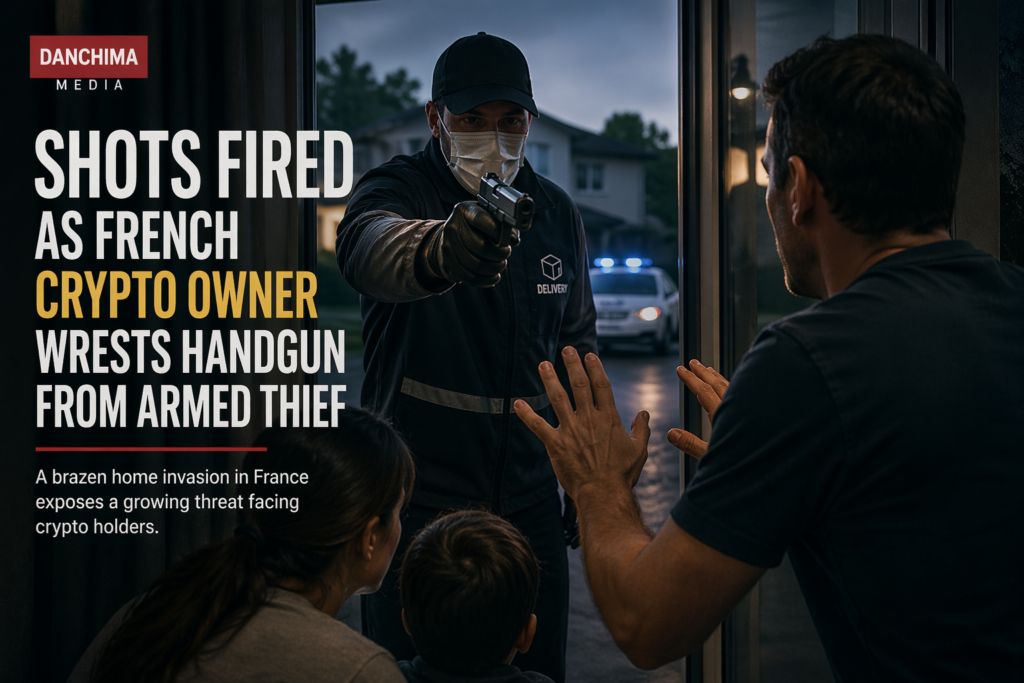
In the early hours of April 11, a quiet home in Saint-Jean-de-Védas, a suburb near Montpellier, became the setting for a disturbing sign of how cryptocurrency-related crime is evolving. What began as a routine knock on the door quickly escalated into a life-threatening confrontation—one that underscores a growing shift from digital attacks to physical ones.
A man working in the crypto sector answered his door expecting a delivery. Instead, he was met by an assailant posing as a driver, who pulled a mask over his face, brandished a handgun, and forced his way inside. The attacker gathered the family into a room and demanded access to private keys, making it clear that this was not a random act, but a targeted operation aimed at bypassing digital security through direct intimidation.
This incident reflects a broader and increasingly alarming trend. Across France, dozens of similar attempted robberies and kidnappings linked to cryptocurrency holders have been reported in recent months. Investigators believe that many of these attacks are not spontaneous but orchestrated, with perpetrators identifying targets through social media activity or public exposure of wealth. Visibility, in this context, has become a risk factor.
What makes this particular case unusual is the outcome. During a brief lapse in the attacker’s attention—reportedly while communicating with an accomplice—the homeowner seized the moment to fight back. A struggle followed, a shot was fired, but no one was injured. In a rare turn of events, the victim managed to disarm the attacker, who fled the scene. Such resistance is uncommon, especially when family members are involved, as most victims are compelled to comply under extreme pressure.


Authorities later apprehended a suspect after a three-day manhunt, but they have not ruled out the involvement of a coordinating figure behind the scenes. This raises concerns that such incidents may be part of more structured criminal operations, where individuals are profiled, targeted, and attacked with calculated precision.
The underlying issue lies in the nature of cryptocurrency itself. While it offers users control over their assets through self-custody, it also removes the safety nets traditionally provided by financial institutions. There is no mechanism to reverse a transaction executed under duress, and no central authority to intervene in real time. In such scenarios, the system functions exactly as intended—leaving individuals fully exposed.
This reality introduces a critical shift in how security must be approached within the crypto space. It is no longer sufficient to rely solely on strong passwords, hardware wallets, or encryption. Personal safety, privacy, and discretion have become equally important components of asset protection. Limiting public exposure, separating identity from financial holdings, and exercising caution in everyday interactions are no longer optional—they are essential.
What unfolded in Saint-Jean-de-Védas is not just an isolated incident; it is indicative of a changing threat landscape. As cryptocurrency continues to grow in adoption and value, it is also attracting a different kind of criminal attention—one that operates not behind screens, but face-to-face.
The implication is clear. In a system designed to eliminate intermediaries, the burden of security falls entirely on the individual. And increasingly, that burden extends beyond the digital realm into the physical world.
- Tottenham’s Busy Summer Continues as Omar Marmoush Becomes Eighth Signing
 Spread the love It’s been a busy transfer window for Spurs as Omar Marmoush becomes their 8th summer signing. Tottenham Hotspur have continued their ambitious… Read more: Tottenham’s Busy Summer Continues as Omar Marmoush Becomes Eighth Signing
 - RUSSIA-UKRAINE WAR: EIGHT SCENARIOS THAT COULD DECIDE HOW THE CONFLICT ENDS
 Spread the loveReports that CIA Director John Ratcliffe may have travelled to Moscow have triggered fresh speculation about the direction of the Russia-Ukraine war and… Read more: RUSSIA-UKRAINE WAR: EIGHT SCENARIOS THAT COULD DECIDE HOW THE CONFLICT ENDS
 - MOURINHO’S NEW ERA: REAL MADRID LEAVE IT LATE
 Spread the loveJose Mourinho’s return to competitive football with Real Madrid got off to a dramatic start as his side secured a thrilling 90th-minute victory… Read more: MOURINHO’S NEW ERA: REAL MADRID LEAVE IT LATE
 - Real Madrid escape first league week Drama at Espanyol. Spread the loveJose Mourinho’s first competitive match of his second spell as Real Madrid manager ended with a thrilling 90th-minute winner from his side at… Read more: Real Madrid escape first league week Drama at Espanyol.
- MARESCA ERA STARTS WITH LAST-GASP CITY DRAMA AS VILLA SUFFER 4–0 HUMILIATION.Spread the loveManchester City have opened the post-Pep Guardiola era with a dramatic 2–1 victory over Bournemouth, thanks to a stoppage-time winner from Josko Gvardiol.… Read more: MARESCA ERA STARTS WITH LAST-GASP CITY DRAMA AS VILLA SUFFER 4–0 HUMILIATION.
- Premier League Has Lost Its Fear Factor: Nobody Is Safe This Season
 Spread the loveManchester City’s post-Pep Guardiola era began with late drama as Josko Gvardiol’s stoppage-time winner secured a 2-1 victory over Bournemouth in Enzo Maresca’s… Read more: Premier League Has Lost Its Fear Factor: Nobody Is Safe This Season
 - Using bigger goals to increase motivation.
 Spread the love Do You Need to Aim Higher? Are you struggling to stay motivated on your journey to success? Have your goals lost some… Read more: Using bigger goals to increase motivation.
 - Wednesday Legs + Core is here — 20 min, no equipment.Spread the loveFocus: Legs + CoreHow hard: 7/10 — legs steady burn, core tight. You should be breathing hard but able to hold form. If… Read more: Wednesday Legs + Core is here — 20 min, no equipment.<br>
- Infantino Faces Growing Opposition as FIFA Election Battle Intensifies.
 Spread the loveThe battle for control of world football is heating up. FIFA president Gianni Infantino is facing growing criticism and mounting opposition as he… Read more: Infantino Faces Growing Opposition as FIFA Election Battle Intensifies.
 - EU Overhauls Driving Licence Rules, Austria Faces Phased Rollout
 Der EU-Führerschein wird digital: Ab 2029 kommen europaweit neue Regeln für Autofahrer. Neben dem Smartphone-Führerschein stehen Änderungen für E-Autos bis 4,25 Tonnen, Automatik-Führerscheine und begleitetes Fahren ab 17 bevor. Auch schwere Verkehrsdelikte sollen künftig EU-weit strengere Folgen haben. Für Österreich bedeutet das eine schrittweise Reform mit weitreichenden Änderungen für Millionen Autofahrer.
 - Premier League’s Most Expensive XI Earns an Incredible £3.37 Million Per Week.
 Spread the loveThe Premier League’s wage bill continues to reach extraordinary levels. For the 2026/27 season, a hypothetical starting XI made up of the league’s… Read more: Premier League’s Most Expensive XI Earns an Incredible £3.37 Million Per Week.
 - Beyond the Scoreline: What the Biggest 2026 FIFA World Cup Upsets Really Reveal
 Spread the loveThe 2026 FIFA World Cup has delivered unforgettable drama. Giants have fallen, underdogs have risen, and football fans around the world have been… Read more: Beyond the Scoreline: What the Biggest 2026 FIFA World Cup Upsets Really Reveal
