



While investors focused on the fragile Iranian ceasefire last week, a desperate scramble for cargoes has been playing out in the oil market, as traders and refiners scour the globe for immediately available supplies.
In the North Sea, the world’s most important physical crude market, traders submitted 40 bids for cargoes last week, only four of which were met by offers. Cargoes for delivery in the coming weeks changed hands at unprecedented prices above $140 a barrel. Elsewhere, refiners have been hunting increasingly further afield for supplies, leading to a series of unusual trades and surging premiums for any oil that’s ready to ship right now.
Traders said the panicky moves across the world’s key physical oil markets demonstrated the scale of the shortfall in crude that’s due to be felt as the loss of supplies from the Middle East leaves a growing gap.
Skyrocketing prices are signaling that some European refiners will likely need to follow those in Asia and cut back production, they said — a move that might help to balance the market for crude oil but would deepen the shortfalls in vital products like diesel and jet fuel.
“There is simply a shortage of crude,” said Neil Crosby, head of research at Sparta Commodities AS. “Physical Brent is a mess and has now risen too far. At this rate even European refiners will have to lower utilization, perhaps as early as next month.”
The frenzy in the physical oil trade stands in contrast to the futures market, where oil for delivery in June dropped 13% last week to close at about $95 a barrel, amid optimism over the ceasefire.
There were some early signs of increased activity in the Strait of Hormuz on the weekend, with two Chinese supertankers and one from Greece moving through the waterway, but traffic still remains well below prewar levels. It takes weeks for crude from the Gulf to reach refineries in Asia and Europe.
In addition, peace talks between the US and Iran this weekend failed to reach an agreement, raising doubts over efforts to end the war and resume energy shipments.

“The final cargoes that transited the Strait of Hormuz before the conflict are now arriving at their destinations. This is where the paper traded markets are meeting physical reality, and the 40-day gap in global energy flows is truly exposed,” Sultan al Jaber, chief executive office of Abu Dhabi National Oil Co., said in a Linkedin post on Thursday.
That gap can be seen in the premium refiners are willing to pay to secure cargoes of crude that are available in the near term. Traders at some Asian refineries, speaking on condition of anonymity, said they were no longer focused on price, and were simply seeking to secure barrels of crude wherever they could to ensure energy security.
Dated Brent – the most important benchmark in the physical oil market used to price millions of barrels a day – hit a record $144 a barrel before the ceasefire, surpassing its 2008 highs even as futures remain far below their record levels.
By Friday it had dropped to $126 a barrel, still more than $30 above June delivery Brent futures, while traders including Trafigura Group and Gunvor Group were bidding more than $22 a barrel above Dated Brent for cargoes of oil in the North Sea for delivery in late April and early May. Supplies from Nigeria for loading next month have been offered as high as $25 per barrel above the benchmark, compared with less than $3 before the Iran war began.
Asian countries, the most reliant on the Strait of Hormuz for crude supplies, have moved beyond their traditional sources to scour the globe for barrels.
Japanese refiners have led a charge to buy up oil from the US, which is exporting at record levels. A buying spree by Chinese refiners has lifted oil shipments from Vancouver in Canada to a record high this month. And Indian refiners have been ramping up purchases from Venezuela. In the first week of April, tankers have loaded almost 6 million barrels for the South Asian country, which is double the volumes seen over the same period in March.
The focus is on barrels that are available as soon as possible — and refiners are willing to pay up for promptness. Japanese refiners have booked smaller-than-typical ships for their US oil purchases, so they can traverse the Panama Canal and get to Japan quicker.
On Saturday, President Donald Trump posted on social media about the “massive numbers” of oil tankers heading to the US to load its oil. Midland WTI at Houston, known as MEH, has risen to a premium of nearly $4 a barrel to the US benchmark, roughly four times its level before the war. Traders said that the premium reflected the time value of the roughly five-day transit to Houston.
The yawning gap between physical crude and futures is partly a reflection of the same dynamic, with barrels commanding a huge premium the sooner they can be delivered — a market condition known as backwardation.
The extreme level of premiums for immediately deliverable crude is putting huge strain on the market, traders and analysts said. Smaller refineries are struggling with greatly increased financing needs due to the higher prices, as well as the challenge of hedging in a market where the physical crude oil they buy is much more expensive than the most liquid derivatives linked to it.
“It’s a massive price risk management headache — on paper the margins are fantastic, but the real cashflows of buying a cargo and deciding to refine it can be quite different,” Roberto Ulivieri, a consultant at Midhurst Downstream and former refining economist for Saudi Aramco.
Some refiners are starting to step back from the market as a result – and the consequence will be a reduction in their output, further squeezing the markets for oil products.
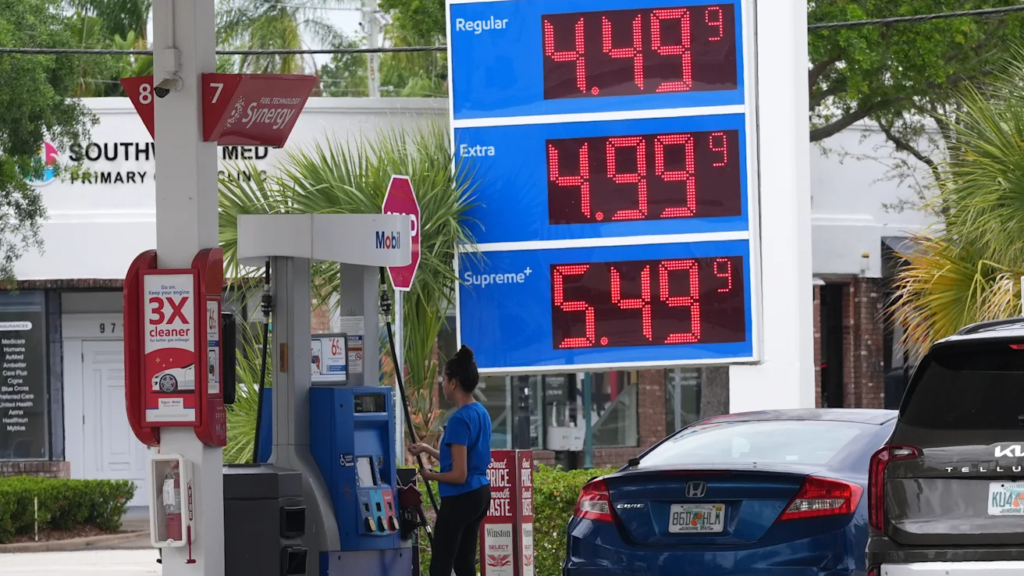
Already, jet fuel and diesel prices have soared to record or near-record highs above $200 a barrel. In the politically crucial US gasoline market, inventories have shrunk to the smallest in almost 16 years, according to the Energy Information Administration.
And as oil buyers descend on the US, analysts are warning that the market shortfall will be felt there next.
“Physical markets are not taking their cues from social media. Instead, they have strengthened relentlessly as disruptions have spread from Asia to the Atlantic basin,” said Amrita Sen, co-founder of consultant Energy Aspects. “If futures don’t catch up to the physical realities, US exports could easily remain elevated, vessel availability permitting, to the point where there isn’t enough crude left for US refineries.”