


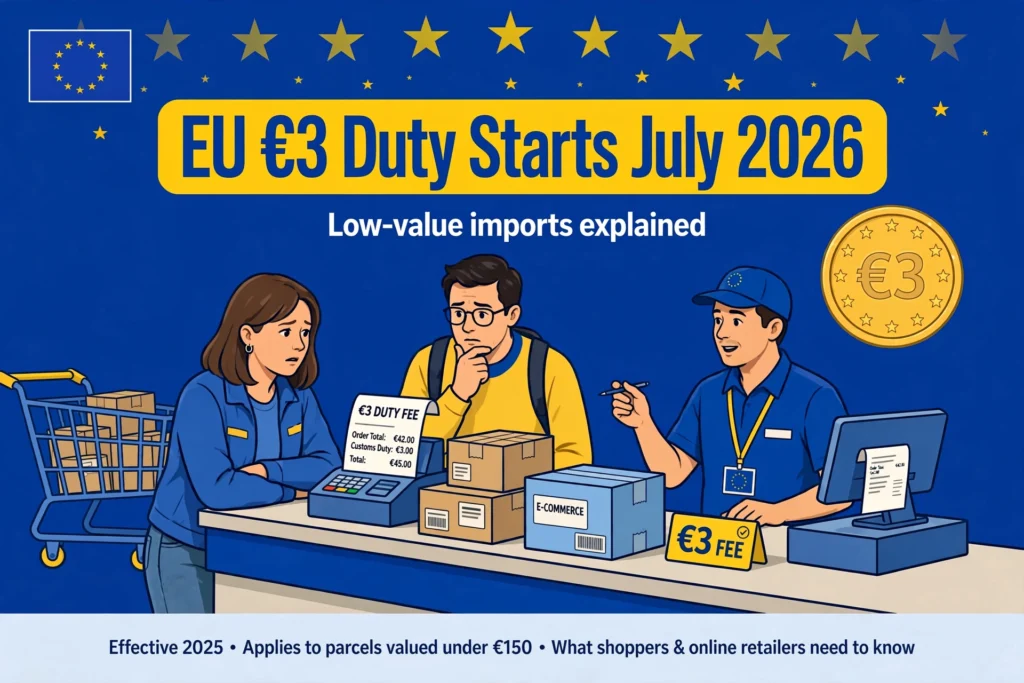
Starting from July 1 2026 the EU is ending its duty-free loophole for cheap online shopping and yes, it will make those €5-€20 orders from Temu, Shein, AliExpress and similar sites more expensive.
Here is what is actually happening:
The €3 rule is not a processing fee, but a customs duty which is starting from 1 July 2026, the EU will abolish the current exemption that lets parcels with an intrinsic value of up to €150 enter duty-free. It will be replaced by a temporary flat €3 customs duty per item.
Here are Key details from the Council and Commission:
The council has said this duty fees will applies per tariff line / item type, not per parcel. Which means, if a buyer ordered 5 T-shirts = 1 item = €3. 1 T-shirt + 1 watch = 2 items = €6.
It will Applies to distance sales B2C — goods bought online from a non-EU seller and shipped directly to you.
Covers sellers registered in IOSS, which is about 93% of all e-commerce flows to the EU.
It is temporary until 1 July 2028. After that, low-value goods will pay normal EU customs tariff rates based on product type, once the new EU Customs Data Hub is live.
The Commission stresses it is legally a duty on business, not a consumer tax, but in practice sellers will pass it on. Why now? In 2025 alone, almost 5.9 billion low-value items entered the EU duty-free. The EU says this created unfair competition, and spot-checks found over 60% of inspected cosmetics, toys, electronics etc. failed EU safety standards.

Don’t confuse it with the other fee
There are two measures being discussed and they are often mixed up: €3 temporary customs duty (1 July 2026) — the one just agreed. It is the customs duty.
Proposed Union handling fee (amount and date still to be determined, expected autumn 2026) — a separate fee to cover customs processing costs, not a duty. Some early reports called this a €2 handling fee per consignment. So some parcels could eventually face both the €3 per-item duty + a handling fee later in 2026.


What it means for you
For consumers in the EU: A €10 item will effectively cost €13 + VAT + any carrier admin charge. The pain is biggest on ultra-cheap multi-item hauls: 3 different cheap items in one order = €9 extra duty.
VAT (usually collected via IOSS at checkout) still applies on top. This is additional.
Delivery may get slower at first as platforms update checkout and customs declarations. From 1 November 2026 Product Identifiers (PIDs) become mandatory to improve traceability.
You won’t normally have to pay at the border yourself — the declarant, usually the seller, marketplace, or their customs representative, is responsible. Only in residual cases where you self-declare will you pay directly.


For businesses / sellers outside the EU:
You must charge and remit correctly via IOSS, file an electronic declaration per tariff line, and include the €3 duty. Marketplaces like Amazon already told sellers FBA and FBM shipments from outside the EU will be affected.
Small parcel business models built on the €150 de minimis advantage lose that advantage. The EU explicitly says this is to level the playing field for EU retailers.
Non-compliant products are more likely to be flagged and blocked due to new data requirements.
This mirrors the US move to end its own de minimis exemption earlier this year.
If you regularly order low-value goods for resale or personal use, the cheapest strategy after July will be consolidating orders by item type, buying from EU warehouses, or from EU-based sellers who have already imported in bulk.
- (no title)
- Everyone Rooted for the Rise. Now They Want the Fall.
- Trump Shuts CNN, Politico and MSNOW Out of the White House
- Vance Backs White House Press Restrictions, Calls Targeted Outlets “Propaganda” Machines
- Spurs, Chelsea and Fulham RELEGATED? Our Shock 2026-27 Premier League Prediction Will Split the Nation