|
Getting your Trinity Audio player ready...
|
Ousmane Dembélé has capped off a sensational season with Paris Saint-Germain by being named UEFA Men’s Player of the Season, after inspiring the French giants to a historic 5-0 victory over Inter Milan in the Champions League final in Munich.
The emphatic win not only secured PSG’s first-ever European crown, but also marked the largest winning margin ever recorded in a Champions League final.
It was a season of transformation for the 28-year-old winger. Early disciplinary issues saw Dembélé dropped by coach Luis Enrique for a group stage clash against Arsenal. But a tactical shift—moving Dembélé into a more central attacking role—proved pivotal. He responded by scoring eight goals in the tournament, playing a crucial part in PSG’s dominance.
Though he didn’t find the net in the final, Dembélé delivered two key assists and was widely hailed as the engine of PSG’s attack. His tireless work rate and leadership even earned extraordinary praise from his coach.
“I would give the Ballon d’Or to Mr. Ousmane Dembélé,” Enrique said. “The way he defended tonight—just that alone could be worth the Ballon d’Or. That’s how you lead a team. Goals, trophies, leadership, defence, his pressing.”
Doué Named Young Player of the Season as PSG Floods UEFA Honors
Meanwhile, PSG’s Desire Doué (19) was awarded UEFA Men’s Young Player of the Season, following a breakout campaign that culminated in a phenomenal final performance. Doué assisted the opener for Achraf Hakimi, then went on to score two goals himself, sealing his reputation as one of Europe’s most exciting young talents.
In total, seven PSG players were named in UEFA’s Team of the Season:
- Gianluigi Donnarumma
- Achraf Hakimi
- Marquinhos
- Nuno Mendes
- Vitinha
- Desire Doué
- Ousmane Dembélé
Adding international flavor to the lineup was Arsenal’s Declan Rice, who impressed with four Champions League goals—two of which were stunning free-kicks against Real Madrid in the quarter-finals.
PSG’s Statement Season
PSG’s triumph is more than a milestone—it’s a statement of intent. With a squad balanced by youth and experience, and led by a revitalized Dembélé, the Parisians finally claimed the European prize that had eluded them for so long.
This season’s UEFA awards show not only individual excellence but the collective rise of PSG as Europe’s new elite force.
- Finding Peace Through Gratitude In Every Season Of This Modern Chaotic Life.

We bridge the friction of modern burnout by anchoring our daily rhythm in radical, unceasing praise. We find the sacred in the mundane, transmuting digital noise into quiet stillness through a disciplined lens of thankfulness. Even amidst life’s harshest winters, we choose to cultivate a heart that remains perpetually in bloom.
The Noise We Were Never Meant to Carry
Somewhere between the third notification and the fifth open tab, most of us lost the plot. We were promised that connection would make us feel less alone, that convenience would buy us more time, that speed would bring us peace. Instead, we inherited a low hum of anxiety that never fully switches off.
Gratitude isn’t a rejection of this modern world — it’s a way of standing inside it without being swallowed by it. It’s the decision to notice, on purpose, what is still good, still working, still worth thanking someone for, even while the noise keeps playing in the background.
Gratitude Is a Discipline, Not a Mood
It’s tempting to think gratitude is something you feel when life is easy — a byproduct of good circumstances. But the version of gratitude that actually changes a life is closer to a practice than a feeling. It’s less “I happen to feel thankful today” and more “I choose to look for what’s true and good, especially on the day I don’t feel like it.”
This is what makes it disciplined rather than decorative. A grateful heart isn’t naive to hardship; it’s simply trained to keep looking past it for something solid to stand on.
Finding the Sacred in the Mundane
You don’t need a mountaintop or a monastery to encounter stillness. It’s available in the ordinary texture of an actual day:
- The first sip of coffee before the house wakes up
- A text from someone who remembered something small about you
- The particular quality of light at the end of an afternoon
- A task finished, even an unglamorous one
None of these moments announce themselves as sacred. They become sacred when we pay attention to them — when we let a small thing be enough, instead of scrolling past it toward the next thing.
Every Season Has Something to Teach
Spring doesn’t ask us to be grateful; it hands us gratitude freely, in blossoms and long light. Winter is a harder teacher. It asks us to practice thankfulness when there’s little visible evidence to justify it — bare branches, short days, a slower pulse to everything.
But this is precisely where a resilient gratitude proves itself. A heart that stays “perpetually in bloom” isn’t one that denies winter exists. It’s one that has learned, through repetition, how to keep its roots warm underground even when nothing is showing above the surface. The bloom isn’t circumstantial — it’s cultivated.
Three Small Practices for a Chaotic Week
Name three things before you check your phone. Before the day’s noise gets a vote, give your own mind the first word. It doesn’t have to be profound — “warm bed, quiet house, another day” is plenty.
Say the thank-you out loud, not just in your head. Gratitude that stays silent tends to stay small. Tell the person. Send the text. Let it become a relationship instead of a private thought.
Let one hard thing coexist with one good thing. You don’t have to choose between honesty about difficulty and gratitude for what remains. Both can be true in the same sentence: “This is hard, and I’m still glad for this.”
A Quiet Kind of Resistance
In a culture built to keep you scrolling, dissatisfied, and slightly behind, choosing gratitude is a quiet act of resistance. It says: I will not let the pace of this world set the condition of my heart. I will notice what’s good on purpose, and I will let that noticing be enough — even in winter, even in the noise, even today.
That’s the whole practice, really. Not the absence of chaos, but a heart trained to keep blooming inside it.
TOP LATEST NEWS
- Argentina Break English Hearts With Late Comeback to Reach World Cup Final.
England’s hopes of reaching their first men’s World Cup final since 1966 were crushed in dramatic fashion as Argentina fought back from behind to win a tense semi-final in Atlanta, scoring twice in the closing stages to complete the turnaround.
Thomas Tuchel’s team appeared to be in control after Anthony Gordon put them ahead in the 55th minute, finishing off a well-placed cross from Morgan Rogers on the right flank. But Argentina refused to fold. Enzo Fernandez leveled the score with a powerful strike from distance just five minutes from full time, and Lautaro Martinez then headed home the winner deep into stoppage time, converting a cross supplied by Lionel Messi.
The result extends England’s long search for a major trophy. The team will now play France in the third-place match, while Argentina prepares to defend its title against Spain in Sunday’s final.
A Combative Opening
The atmosphere inside and around the stadium was electric, and it spilled onto the pitch in a rough first half that produced 19 fouls. American official Ismail Elfath had his hands full trying to manage the physical exchanges.
Fernandez had an early chance with a shot from range that narrowly missed the target, but England struck first when Rogers delivered a precise ball into the box for Gordon to head — or in this instance, finish — at the far post.
Rattled by falling behind, Argentina pushed forward and came close to an equalizer almost immediately, only for goalkeeper Jordan Pickford to produce a sharp reaction save to deny a header from Nico Gonzalez. Moments later, Alexis Mac Allister struck the post with a header of his own as Argentina’s pressure mounted.
The Collapse
England held on until five minutes before the end, when Fernandez finally beat Pickford from around 25 yards out despite the goalkeeper’s best effort. Tuchel had switched to a back four of central defenders to shore things up, but Argentina’s momentum could not be stopped. Mac Allister rattled the woodwork a second time before Martinez completed the comeback in the 92nd minute, sending Argentina through to the final and ending England’s campaign in heartbreaking fashion.
Analysis: Tuchel’s Late Caution Backfires
England has a history of losing control of matches it once dominated — a pattern that resurfaced under previous manager Gareth Southgate — and Tuchel now shares in that criticism. After Gordon’s goal, England gradually retreated into a defensive posture, eventually loading the pitch with extra defenders. That shift included substituting off goalscorer Gordon for Ezri Konsa with 18 minutes remaining, and bringing on the physically imposing Dan Burn — a move that ultimately did not pay off.
As England dropped deeper and deeper, they invited sustained Argentine pressure and were eventually overrun. Given how close they came, this defeat may sting more than most of England’s recent tournament exits.
Analysis: Messi Delivers When It Matters Most
Lionel Messi was relatively quiet for long stretches of the semi-final, but his influence in the final minutes proved decisive yet again. He set up Fernandez’s equalizer and then whipped in the cross — using his right foot — that Martinez converted for the winning goal.
Argentina’s improvement in the second half came as they moved away from some of the rougher tactics that marked their first-half approach, instead simply outlasting an England side that retreated into its own defensive third under sustained late pressure.
Messi will now have the opportunity to win a second World Cup title at age 39. Standing in his way is Spain’s rising star Lamine Yamal, part of a European champion side that impressed in a commanding win over France in the other semi-final.
*Reporting based on match coverage from Atlanta. — Danchima Media*
- Rodri Reflects on World Cup Glory After Spain’s Historic Win Over Argentina

Golden Ball winner credits resilience, bravery and team maturity after inspiring Spain to World Cup triumph and completing an unforgettable comeback from injury.
Rodri has admitted it may take time for Spain’s World Cup triumph to fully sink in after captaining his country to a memorable 1-0 victory over Argentina in the final.
The Manchester City midfielder delivered another dominant display and capped off an outstanding tournament by lifting the trophy before being named the Golden Ball winner as the competition’s best player.
Reflecting on the achievement, Rodri said he was overwhelmed by the magnitude of the moment, especially after overcoming the serious ACL injury he suffered in September 2024.
“We’re all still in shock,” he said. “It’s difficult to describe with words. Right now, it feels like we’re living in a dream, but it’s been an incredibly difficult journey for me.”
The Spain captain hopes his comeback will inspire others facing setbacks, insisting that adversity can be overcome with resilience and a positive mindset.
“I want younger generations to see my story as proof that when life knocks you down, you can get back up again. That’s the philosophy I’ve always lived by. Sometimes things go your way, sometimes they don’t, but you must always stay positive.”
Rodri also revealed the message he delivered to his teammates before the final, urging them to face Argentina without fear.“I told the players we had to be brave, look them in the eyes and go after the game. Whether football rewards you with the World Cup or not, you have to be courageous.”
He expressed gratitude to everyone who supported him through his rehabilitation, while also acknowledging his own determination.
“I want to thank everyone who helped me through those difficult moments. But I also want to thank myself for never giving up.”
Looking back on Spain’s progress since winning the European Championship, Rodri believes the team’s maturity has been the key factor behind their World Cup success.
“This team has grown every single day. We faced different opponents, different styles and different challenges, and we found ways to handle them all. That’s the sign of a team that has matured.”
He added that Spain’s latest triumph is another milestone for a remarkable generation of players.“We’re making history for our country, not just because we won, but because of the way we achieved it.”

- Rodri Leads Spain to 2026 FIFA World Cup Glory

Spain have been crowned champions of the 2026 FIFA World Cup after edging Argentina 1-0 in a dramatic final that went into extra time. A decisive strike from former Manchester City forward Ferran Torres secured victory for La Roja, ending Argentina’s reign as world champions.
The triumph marks a historic milestone for Spain, who lift the World Cup for only the second time in their history, 16 years after their memorable success in South Africa in 2010.
Rodri’s three Cup won this 2025/2026 season For Manchester City midfielder and Spain captain Rodri, the victory further cements his place among football’s all-time greats. The midfield maestro now joins an exclusive group of just 11 male players to have won the FIFA World Cup, UEFA Champions League, and the Ballon d’Or during their careers.
Spain’s latest achievement also strengthens their legacy on the international stage. Already reigning European champions before the tournament, they now become only the third nation—alongside Brazil and Argentina—to have held both the continental and world titles on more than one occasion.

Although Spain opened their campaign with an unexpected goalless draw against Cape Verde, they quickly found their rhythm, finishing top of Group H with victories over Saudi Arabia and Uruguay.
Their impressive run continued with a commanding 3-0 win over Austria in the Round of 32 before dramatic knockout victories against Portugal and Belgium booked a heavyweight semi-final clash with France.
Rodri delivered one of his finest performances in the tournament against the French, dominating midfield by winning 11 duels—more than France’s entire midfield combined—as Spain secured a convincing 2-0 victory to reach the final.
In the championship match, Rodri once again dictated the tempo and provided the leadership expected of a captain. Spain maintained their remarkable defensive record, conceding only one goal throughout the tournament and never trailing in any match.

Countries that has won 🏆 world 🌎
Ferran Torres’ extra-time winner ultimately sealed a deserved victory, handing Spain football’s biggest prize once again and completing an outstanding World Cup campaign.
Rodri’s commanding performances from start to finish were instrumental in Spain’s success, reinforcing his reputation as one of the finest midfielders of his generation.
Congratulations to Rodri and Spain on their historic 2026 FIFA World Cup triumph.
- Spain Crowned 2026 FIFA World Cup Champions After Extra-Time Victory Over Argentina

Spain Crowned 2026 FIFA World Cup Champions After Extra-Time Victory Over Argentina
East Rutherford, New Jersey — Spain have been crowned champions of the 2026 FIFA Men’s World Cup after defeating defending champions Argentina 1-0 in a tense extra-time final.
After 90 minutes of determined defending and missed opportunities at both ends, the deadlock was finally broken in extra time when Ferran Torres scored the decisive goal to hand La Roja their second FIFA World Cup title.
Spain controlled much of the contest with composed possession and consistent attacking pressure, while Argentina remained disciplined at the back and looked to strike on the counterattack. Despite their resilience, the reigning champions were unable to find a breakthrough and eventually fell short in their bid to retain the trophy.
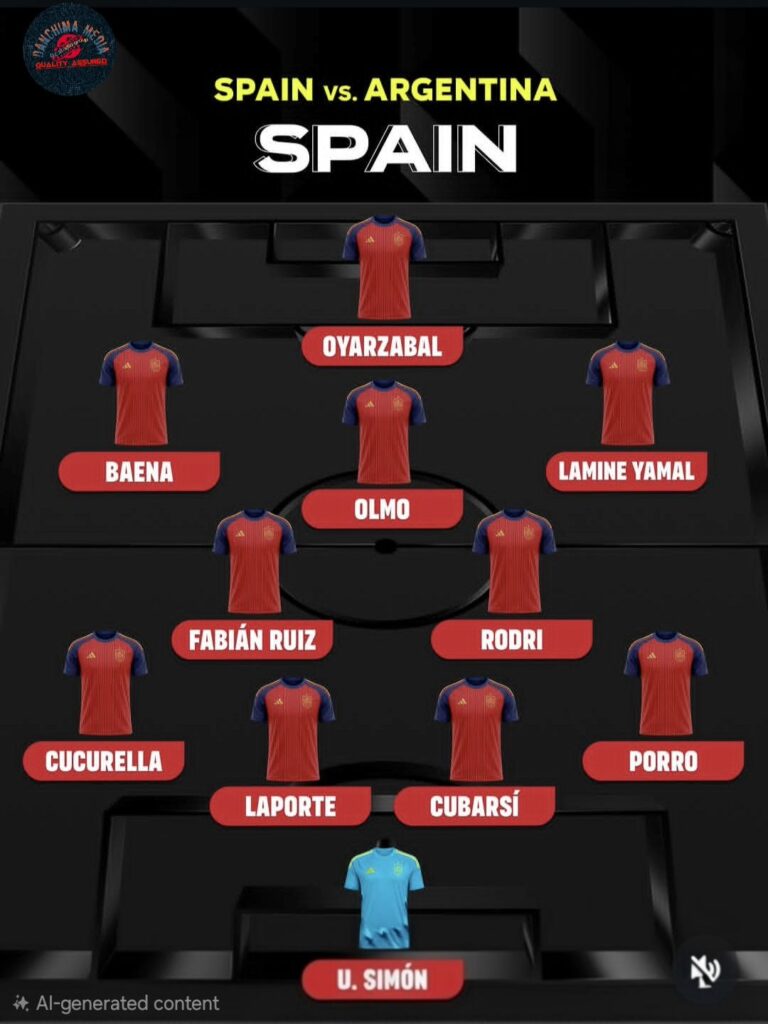
The victory caps an impressive tournament for Spain, who combined tactical discipline, attacking quality, and defensive solidity throughout the competition. Argentina, meanwhile, finish as runners-up after another memorable World Cup campaign that showcased their determination and fighting spirit.
The 2026 tournament, jointly hosted by the United States, Canada, and Mexico, was the first FIFA World Cup to feature 48 teams. It delivered thrilling matches, dramatic upsets, and standout individual performances before concluding with Spain lifting football’s most prestigious trophy.
Spain’s triumph marks the end of a historic World Cup and the beginning of a new chapter for one of international football’s most successful nations.
- Spanish Startup Unveils Bladeless Wind Turbine That Generates Electricity by Swaying in the Wind

A Spanish company has developed a bladeless wind turbine that generates electricity by swaying instead of spinning. Discover how the innovative technology works, its advantages, limitations, and future potential.
A Spanish clean-energy company is challenging the traditional design of wind turbines with an innovative technology that produces electricity without rotating blades.
Instead of the familiar three-bladed turbines seen in wind farms around the world, the new system features a tall, slender mast that gently sways back and forth in the wind. The motion created by these vibrations is converted into electrical energy, offering a quieter and mechanically simpler approach to wind power.
The technology, developed by Spanish startup Vortex Bladeless, is designed to complement—not replace—conventional wind turbines by providing renewable energy solutions for locations where large turbines are impractical.
How the Bladeless Turbine Works
Unlike traditional wind turbines that rely on spinning blades, the bladeless design takes advantage of a phenomenon known as vortex-induced vibration.
As wind passes around the cylindrical mast, it creates alternating air vortices that cause the structure to oscillate naturally. This effect, scientifically known as the von Kármán vortex street, has long been viewed as a structural challenge for engineers because it can damage bridges, towers and chimneys.
Vortex Bladeless has instead turned this natural phenomenon into an energy source. The mast is mounted on a specially designed elastic rod that allows it to resonate at specific wind speeds. Its side-to-side movement drives an alternator, which converts the mechanical motion into electricity without requiring blades, gearboxes or complex rotating components.
A Simpler Alternative to Conventional Turbines
Traditional wind turbines remain among the most efficient forms of renewable energy, but they are also expensive to transport, install and maintain. Their massive blades require large open spaces, generate noise, and have raised concerns about bird and bat collisions in some environments.
The bladeless design addresses several of these challenges by offering:
Fewer moving parts
Reduced maintenance requirements
Quieter operation
Lower manufacturing weight
Reduced risk to birds and bats
Easier installation in urban and remote locations
These advantages make the technology particularly attractive for off-grid applications, remote monitoring stations, agricultural equipment, smart-city infrastructure and small buildings.
Current Limitations
Despite its innovative design, the technology is still in the early stages of commercial development.
The company’s largest prototype currently produces around 100 watts of electricity far below the multi-megawatt output of modern utility-scale wind turbines.
Because of this significant difference in power generation, bladeless turbines are unlikely to replace conventional wind farms. Instead, they are expected to serve niche applications where traditional turbines are either impractical or too costly.
Researchers continue to improve the system’s efficiency, durability and scalability as development progresses.
A Complement to Renewable Energy
Energy experts increasingly believe that the future of clean power will depend on combining multiple renewable technologies rather than relying on a single solution.
Bladeless wind turbines could work alongside solar panels, battery storage systems and conventional wind farms to provide electricity in urban environments, environmentally sensitive areas and remote communities.
Although still an emerging technology, the concept demonstrates how engineers are reimagining one of humanity’s oldest renewable energy sources by turning wind-induced vibrations into usable electrical power.
Key Takeaways
Spanish company Vortex Bladeless has developed a wind turbine with no rotating blades.
The device generates electricity by converting wind-induced vibrations into electrical energy.
Its simple design reduces maintenance, noise and potential risks to birds.
Current prototypes produce about 100 watts, making them suitable for small-scale applications rather than utility-scale power generation.
The technology is expected to complement existing renewable energy systems rather than replace conventional wind farms.
- Late Argentina Surge Ends England’s World Cup Dream
England’s hopes of reaching their first men’s World Cup final since 1966 were dashed in painful fashion as Argentina rallied from behind to win a tense semi-final in Atlanta, scoring twice in the closing stages to complete the turnaround.
Thomas Tuchel’s team appeared to be in control after Anthony Gordon put them ahead just after the hour mark, but Argentina responded with a stunning finish from Enzo Fernandez five minutes from the end, followed by a stoppage-time header from Lautaro Martinez off a Lionel Messi assist. The result sends Argentina through to defend their title against Spain, while England must now settle for a third-place playoff against France.
A Bruising, Chaotic Opening
The occasion lived up to its billing from the first whistle, with a combative and error-strewn opening half that produced nearly twenty fouls as American official Ismail Elfath repeatedly struggled to manage the tempers on show. Fernandez tested England early with a shot from distance that drifted narrowly wide, but it was England who broke the deadlock — Morgan Rogers delivering a precise ball from the right flank for Gordon to finish clinically at the far post.
Argentina responded with intent. Goalkeeper Jordan Pickford produced a stunning reaction save to deny a header from Nico Gonzalez, keeping England’s lead intact through mounting pressure. Alexis Mac Allister then rattled the crossbar-post area, striking the frame of the goal, before Argentina finally found their equalizer with roughly five minutes remaining — a driven effort from distance that beat a well-positioned Pickford. Tuchel had reorganized his backline with four central defenders to shore things up, but Argentina’s momentum proved impossible to contain. Mac Allister struck the woodwork a second time, and in the 92nd minute, Martinez headed home the winner to complete the comeback.
Why England Fell Short
Much of the post-match scrutiny has centered on Tuchel’s tactical approach in the closing stages. As has happened before for England sides in similarly pressurized moments, the team appeared to retreat into a defensive posture rather than press their advantage. Substituting off goal-scorer Gordon for the more defensively-minded Ezri Konsa with under twenty minutes remaining, and shifting to a five-man backline, invited sustained Argentine pressure rather than relieving it. England ultimately couldn’t hold out, and the manner of the collapse — so close to a historic final berth — will sting all the more given the context.
Messi’s Late Influence Proves Decisive
For Argentina, it was once again Messi who provided the spark when it mattered most. Though relatively quiet for long stretches, the 39-year-old set up Fernandez’s leveler and then supplied the cross — struck with his right foot — that Martinez converted for the winner. Argentina’s improved second-half showing came as they abandoned some of the gamesmanship that marked their first-half approach, instead overwhelming an England side that had retreated into a defensive shape late on.
Messi will now have a chance to add a second World Cup title to his collection, with Argentina facing a Spain side built around emerging star Lamine Yamal — the reigning European champions, who impressed in eliminating France in the tournament’s other semi-final.
What’s Next
- Saturday, 22:00 BST: England vs. France — third-place playoff
- Sunday, 20:00 BST: Spain vs. Argentina — World Cup final
- Trump Predicts Lower US Inflation by End of 2026 as Falling Oil Prices Could Ease Cost Pressures
Trump Predicts Lower US Inflation by End of 2026 as Oil Prices Fall
US President Donald Trump has expressed confidence that inflation in the United States will ease before the end of 2026, saying lower oil prices could help bring down the overall cost of living.
Speaking during an interview with Fox Business on Wednesday, Trump was asked whether he expects inflation to be lower by the end of the year. He responded, “I think so,” explaining that his optimism is based largely on the expectation that energy prices will decline.
According to Trump, oil prices may continue to fluctuate in the short term, describing the market as moving like a “yo-yo” with prices rising and falling. However, he believes that once the conflict involving Iran comes to an end, crude oil prices could fall significantly.
“When this is over, oil is going to drop like a rock,” Trump said, suggesting that lower energy costs would help reduce inflationary pressures across the US economy.
Energy prices play a major role in inflation because they influence transportation, manufacturing, and household expenses. A sustained drop in oil prices could therefore contribute to slower price growth if market conditions develop as Trump anticipates.
- ‘The Best Team Won’: Pundits and Fans Divided After England’s World Cup Heartbreak

England’s dramatic 2-1 defeat to Argentina in the FIFA World Cup semi-final has sparked passionate debate among football pundits and supporters, with discussions ranging from Argentina’s gamesmanship to England’s tactical collapse and the nation’s World Cup expectations.
While emotions continue to run high, one conclusion has emerged from many analysts: Argentina capitalised on England’s mistakes and deserved their place in the final.
Argentina’s ‘Dark Arts’ Spark Debate
One of the biggest talking points was Argentina’s use of football’s so-called “dark arts” during the match. From slowing the tempo to psychological tactics and post-match celebrations, many England supporters questioned whether the South Americans crossed the line.
However, former professionals argued that such behaviour has become part of modern football.
According to one pundit, these incidents should be managed by referees rather than becoming major controversies.
> “That’s how the game is played these days. If the referee believes players are breaking the rules, it’s his responsibility to punish it early.”
The discussion also touched on Argentina’s flag celebrations after the final whistle, with some believing FIFA should investigate if competition rules were breached, while others dismissed the incident as unnecessary controversy.
England’s Expectations Under the Spotlight
The defeat also reignited debate over England’s football culture.
A Scottish caller argued that England’s supporters build unrealistic expectations every World Cup, pointing out that the Three Lions have only lifted the trophy once despite decades of talented squads.
He suggested that England’s confidence is often viewed elsewhere in Britain as arrogance rather than optimism.
England supporters pushed back strongly, insisting there is nothing arrogant about believing in a talented team capable of challenging for the title.
They argued that reaching another World Cup semi-final proves England remain one of football’s strongest nations, even if the wait for another trophy continues.
Where Did England Lose the Match?
Many fans focused on England’s defending during Argentina’s winning goal.
Questions were raised about the positioning of defenders after Lionel Messi collected possession inside the penalty area before delivering the decisive cross for Lautaro Martínez.
Supporters questioned why England’s defenders failed to close Messi down quickly enough, allowing him time to create the winning opportunity.
Others believed the turning point came much earlier. After taking a 1-0 lead, England gradually retreated into a defensive shape, surrendering possession and inviting relentless Argentine pressure. That tactical shift allowed Argentina to dominate the closing stages and eventually complete another remarkable comeback.
Argentina Continue Their Winning Formula
The victory once again highlighted Argentina’s remarkable resilience throughout the tournament.
For the third consecutive knockout match, they absorbed pressure before producing decisive moments late in the contest. Their patience, experience and clinical finishing have become defining characteristics of their World Cup campaign.
Danchima Sport Updates Verdict
While discussions about refereeing decisions, gamesmanship and celebrations will continue, football is ultimately decided by performances on the pitch.
England showed promise for long periods but failed to maintain control after taking the lead. Argentina remained patient, created the clearer chances in the closing stages and punished England’s defensive lapses.
In the end, the result reflected the balance of play.
Argentina march into the FIFA World Cup 2026 final, while England are left to reflect on another painful near miss.
Stay with Danchima Sport Updates for expert analysis, World Cup final coverage, player ratings and post-match reactions.
- Spain Favoured, But Argentina’s Late-Game Mentality Could Decide World Cup Final

The FIFA World Cup 2026 is set for a thrilling conclusion as Spain and Argentina prepare to battle for football’s biggest prize. Following Argentina’s dramatic comeback victory over England in the semi-finals, attention has shifted to what promises to be an unforgettable final.
Argentina’s 2-1 victory over England once again highlighted a growing trend throughout their World Cup campaign. Rather than dominating from the opening whistle, Lionel Scaloni’s side has repeatedly shown remarkable patience, absorbing pressure before striking decisively in the closing stages of matches.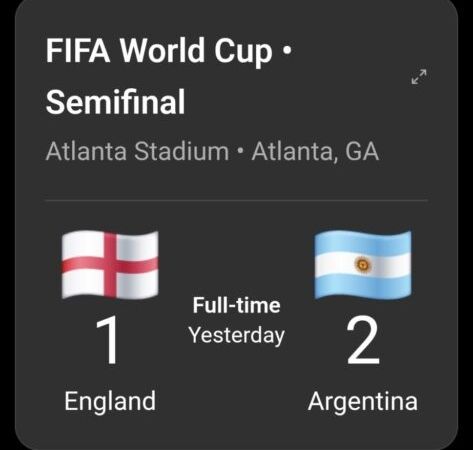
This approach was evident in earlier knockout victories over Switzerland and Egypt, and once again against England. The Three Lions controlled large periods of the match and held a 1-0 lead before Argentina dramatically turned the contest around in the final minutes, exposing tired defenders and capitalising on late mistakes.

Is Argentina’s Late Surge a Deliberate Strategy?
One of the biggest talking points ahead of the final is whether Argentina intentionally conserve energy before launching relentless attacks during the final 15 to 20 minutes.
While it is difficult to confirm whether this is a planned tactical approach, the pattern has become impossible to ignore. Argentina appear comfortable allowing opponents to enjoy possession and expend energy before increasing their intensity late in games when fatigue begins to affect defensive concentration.
If this is indeed part of their game management, it has proved highly effective throughout the tournament.
Can Spain Avoid the Same Trap?
Spain present a very different challenge. Unlike England, Spain are unlikely to chase the game unnecessarily. Their possession-based philosophy allows them to dictate the tempo while conserving energy themselves. Rather than committing numbers forward recklessly, Spain prefer to wear opponents down through patient passing and intelligent movement.
However, Spain must remain alert throughout the entire 90 minutes. Should they lose concentration late in the match, Argentina have already demonstrated that they possess the quality and belief to punish even the smallest defensive lapse.
The Midfield Battle Will Be Crucial
Although teenage sensation Lamine Yamal has captured global attention with his creativity and fearless attacking play, the midfield battle could ultimately determine who lifts the trophy.
Spain’s ability to control possession, maintain rhythm and prevent Argentina from launching dangerous counter-attacks will be just as important as their attacking brilliance. If Spain dominate midfield, they can limit Argentina’s opportunities to produce another late comeback.
The World Cup final promises to be one of the closest contests of the tournament.
Spain enter the match with greater consistency, excellent midfield control and a possession-based system capable of frustrating opponents. Argentina, meanwhile, have built a reputation for resilience, patience and delivering when it matters most.
If the match remains level entering the final 20 minutes, Argentina’s confidence and experience could once again become decisive. However, if Spain maintain their composure and continue playing their football until the final whistle, they may finally break Argentina’s late-game momentum.My Prediction: Spain 2-1 Argentina (with extra time remaining a strong possibility).
Third-Place Playoff Prediction
Before the final, England and France will battle for third place. England will be looking to recover from the heartbreak of their semi-final defeat, while France will be determined to finish the tournament on a positive note after missing out on another World Cup final.
The encounter is expected to be evenly matched, but France may hold a slight psychological advantage.
Prediction: France 2-1 England.
As football fans around the world prepare for the final weekend of the FIFA World Cup 2026, one thing is certain—the tournament has delivered unforgettable drama, and the final chapter promises to be no different.
Stay tuned to Danchima Sport Updates for comprehensive match analysis, breaking news, post-match reactions and exclusive coverage throughout the FIFA World Cup 2026.
- England vs Argentina: A Football Rivalry That Goes Beyond the Pitch

As England and Argentina prepare to face each other in the 2026 FIFA World Cup semi-final, emotions are running high on both sides. Few international football rivalries carry as much history, passion, and symbolism as this iconic matchup.
Despite the intense history between the two nations, Argentina head coach Lionel Scaloni has urged everyone to keep the focus firmly on football.
Speaking ahead of the clash, Scaloni dismissed attempts to connect the semi-final with the 1982 Falklands/Malvinas conflict.
> “It’s just a football match. Let’s not look for other stuff. England are a great team with a great manager. This is about football, nothing else.”Argentina midfielder Rodrigo De Paul echoed that message while acknowledging the emotional significance the fixture holds for many Argentinians.
He admitted that memories of Diego Maradona and the nation’s past remain part of Argentina’s football culture. However, he stressed that political issues should remain separate from the game.> “We remember our heroes and our history, but this is a football match. Our objective is to win and reach the World Cup final.”
A Rivalry Built on Football History
England and Argentina have produced some of the most unforgettable moments in World Cup history.
The rivalry includes:
The dramatic quarter-final at the 1986 World Cup, remembered for Maradona’s “Hand of God” goal and his stunning solo effort known as the “Goal of the Century.”
England’s penalty shootout victory at the 1998 World Cup.
Their tense meeting in the 2002 group stage, where England claimed a narrow 1-0 victory.Each encounter has added another chapter to one of international football’s greatest rivalries.
Eyes on the Final
While history will always surround this fixture, both teams insist that their focus is solely on securing a place in the 2026 FIFA World Cup final.
With world-class talent on both sides, supporters can expect another memorable chapter in a rivalry defined by passion, quality, and unforgettable moments.
This semi-final is more than a clash between two football giants—it is a test of composure, tactical discipline, and championship ambition. While history provides the backdrop, the players of today have the opportunity to create a new story on the world’s biggest football stage.
- How Norway Built a Golden Football Generation: Turf, Coaching, and Togetherness

Norway, a nation with roughly the same population as Scotland, has emerged as one of the standout teams of the 2026 World Cup — and the credit goes well beyond Erling Haaland.
Haaland, the Manchester City forward who has scored seven goals so far in the tournament, remains the team’s headline act, alongside Arsenal and Norway captain Martin Odegaard. But they represent just the most visible output of a much broader system. Of the 26 players in Norway’s World Cup squad, 17 currently play for clubs in the Premier League, Bundesliga, La Liga, or Serie A — and most came up through Norway’s national youth development framework, known as the National Team School (NTS), founded in 2013.
The contrast with Scotland is striking. Both countries share similar population sizes and both endured a 28-year absence from the World Cup after France 1998. Yet while Scotland exited at the group stage this summer, Norway advanced past both Ivory Coast and Brazil in the knockout rounds and now face England in the quarter-finals.
Two Decades in the Making
Hakon Grottland, the Norwegian Football Federation’s head of player development, says the country’s current success reflects more than 20 years of deliberate planning. He recalled that when he joined the federation in 2010, reaching a World Cup felt like a distant dream, given how long Norwegian football had been living off the memory of 1998.
According to Grottland, two developments were decisive: a nationwide push to build artificial pitches between 2000 and 2010, and a coaching overhaul sparked by the creation of the NTS.

From Ice to All-Weather Football
Norway has built or upgraded a striking number of artificial pitches over the past decade — more than 500 newly constructed and nearly 600 renovated between 2016 and 2025 alone. For a country with harsh winters, this transformed football from a seasonal activity into a year-round pursuit. Grottland remembered playing on icy, unreliable surfaces as a young player; today’s conditions are dramatically different.
That shift also changed the style of play. Norway’s football identity in the 1990s was built on effective but unglamorous, defensively minded football. More consistent playing surfaces opened the door to a more technical approach — something now embodied by playmaker Odegaard. Grottland noted, half-jokingly, that the pendulum may have swung too far in the other direction, joking that Norway now struggles to produce enough defenders.
Oil Wealth and Gambling Revenue Fund the Game
Norway’s enormous oil reserves — the largest in Europe outside Russia — have made it one of the wealthiest nations per capita in the world, with an economy that outperforms both the UK and the US on that measure.
Less obviously, gambling revenue has also played a major role in funding grassroots sport. Norway tightly regulates betting, and its state-owned operator, Norsk Tipping, channels 64% of its proceeds into sport, largely toward facilities. In 2026 alone, that amounted to more than 2 billion kroner — roughly £152.7 million — directed toward sports infrastructure.
A System, Not an Academy
Grottland pointed to a second wave of change between 2010 and 2020, when Norway’s leading clubs, regional federations, and districts began investing heavily in developing young talent. That effort intensified after Norway missed out on Euro 2012 qualification, prompting the federation to launch the NTS — known in Norwegian as Landslagsskolen — in 2013.
The results are visible in the current squad: of the 15 players who started Norway’s 2-1 win over Brazil, 14 had represented the country at youth level, and 11 had come through the NTS pathway from as early as under-15 or under-16 level.
Grottland was careful to clarify that the NTS isn’t a centralized academy in the mold of France’s Clairefontaine. Instead, it functions as a connective structure linking grassroots clubs, regional programs, top clubs, and the federation. Unlike systems where elite clubs focus purely on talent production while grassroots clubs exist just for recreation, he said, in Norway “everyone’s in it together.”
That grassroots ethos was on display before the tournament, when the squad posed for a team photo wearing the jerseys of the clubs where they first started playing.
Keeping Doors Open Longer
One notable difference from countries like England — where top academies often recruit children as young as eight — is that Norwegian players typically remain with their local grassroots clubs until age 12. Grottland described this as a deliberate philosophy: avoiding premature judgments about who will or won’t make it.
He pointed to Haaland as proof the approach works. Haaland joined national talent camps within the NTS structure at 14, but at the time, no one predicted he would become one of the best players of his generation.
Odegaard was the exception. Grottland said the entire philosophy behind the NTS was shaped by encountering Odegaard at age 11 — a player who would go on to sign for Real Madrid at 16 for €4 million. Grottland said the NTS defines talent less by physical measurables like speed or ball control, and more by a player’s love of the game and sense of ownership over their own development and the team’s. He said he’d never encountered a child with that quality quite like Odegaard.
Team Over Individual
Grottland said the core values the NTS instills are safety, security, and togetherness — values he believes are now paying off on football’s biggest stage, where, in his words, no single player is bigger than the team.
He connected that ethos directly to the “Viking row” celebration that has become a signature sight at this World Cup, in stadiums and even in Times Square, describing it as a physical expression of collective identity.
What’s Next for the Domestic League
One open question is whether this player pipeline will eventually strengthen Norway’s domestic league, given that only four members of manager Stale Solbakken’s squad currently play in Norway — three of them for Bodo/Glimt, whose run to the Champions League last-16 last season offered a glimpse of what’s possible.
Grottland said producing and selling players abroad remains one of Norwegian football’s central goals, but argued that goal and domestic development aren’t in conflict — pointing to recent growth in the Norwegian league itself.
Solbakken, for his part, credited the current squad’s blend of veteran and emerging players to sustained effort across the system rather than any single golden generation. “We have players who are around 30 or older, we have players who are around 18 and 20 and then players who are in the middle who are peaking,” he said. “I don’t know if it’s a generation but it’s hard work from the clubs, hard work from the federation.”
- The Ultimate AI Toolkit for Creators, Businesses and Professionals

Artificial intelligence is no longer a futuristic concept—it has become an essential tool for businesses, creators, students, developers, marketers and entrepreneurs. Whether you’re writing articles, designing graphics, editing videos, building websites, creating music or automating your workflow, AI can help you accomplish more in less time.
At Danchima Media Ltd., we’ve carefully selected some of the world’s leading AI platforms to help you work smarter, create faster and stay ahead in the digital economy.
Why AI Matters Today
Businesses that embrace AI are increasing productivity, reducing costs and reaching audiences faster than ever before. Instead of spending hours on repetitive tasks, AI allows you to focus on creativity, innovation and business growth.
Whether you’re launching a startup, running a YouTube channel, managing social media or operating an online business, these AI tools can transform the way you work.
Featured AI Tools
ChatGPT
Your intelligent writing partner for content creation, research, coding, customer support, brainstorming and education.
Claude
Perfect for long-form writing, document analysis, professional reports and strategic thinking.
Gemini
Google’s powerful AI assistant for productivity, research and multimodal content creation.
Perplexity
An AI-powered search engine that delivers cited answers for research and fact-checking.
DeepSeek
Excellent for coding, reasoning, technical documentation and software development.
Grok
An AI assistant designed for real-time conversations and current information.
Microsoft Copilot
Boost productivity across Microsoft Office, Windows and enterprise workflows.
Ideogram
Generate stunning AI images with exceptional text rendering for posters and branding.
Leonardo AI
Professional-quality AI artwork, game assets, product mockups and illustrations.
Midjourney
Create breathtaking artistic images and concept designs.
NightCafe Studio
Turn your imagination into AI-generated digital artwork.
SeaArt AI
Produce realistic portraits, anime artwork and commercial visuals.
Adobe Firefly
Generate commercial-ready graphics, illustrations and creative assets.
Canva
Design social media graphics, presentations, logos and marketing materials using AI.
VEED.io
Fast online AI video editing with subtitles, translations and voice enhancements.
InVideo AI
Create professional videos from simple text prompts.
YouTube Create
Simplify mobile video editing for YouTube creators.
ElevenLabs
Generate natural AI voices for podcasts, audiobooks, videos and narration.
Suno AI
Create complete songs with lyrics, vocals and professional music production.
Firebase Studio
Accelerate application development with Google’s development ecosystem.
Google Labs
Explore Google’s latest experimental AI technologies.
Manus AI
An intelligent AI agent designed to automate complex workflows and productivity tasks.
Meta AI
A conversational assistant integrated across Meta platforms.
Hailuo AI
Generate cinematic AI videos with realistic motion and storytelling.
Vheer AI
Create portraits, avatars and creative visual content with ease.
—
Who Can Benefit?
These AI tools are ideal for:
Content creators
Journalists
Businesses
Students
Teachers
Software developers
Digital marketers
Musicians
Graphic designers
Video editors
Social media managers
Entrepreneurs
Podcasters
Online educators
Why Choose Danchima AI Agents?
At Danchima Media Ltd., we don’t just introduce AI tools—we help individuals and businesses understand how to use them effectively.
Our mission is to make artificial intelligence practical, accessible and profitable through:
AI tutorials
Business automation guides
AI news and updates
Prompt engineering
Digital marketing strategies
Content creation training
Productivity workflows
AI tool reviews and comparisons
Whether you’re a beginner or an experienced professional, Danchima AI Agents is your trusted resource for navigating the rapidly evolving world of artificial intelligence.
The Future Starts Now
AI is reshaping every industry—from journalism and education to healthcare, finance and entertainment. Those who learn to work alongside AI today will be better positioned to lead tomorrow.
Join the growing Danchima AI community and discover the tools, knowledge and strategies that can help you unlock new opportunities, automate repetitive work and create with confidence.
Danchima Media Ltd. — Powering the Future with Artificial Intelligence.
- The EU is ending its duty-free loophole for cheap online shopping from Temu, Shein, AliExpress and similar sites

Starting from July 1 2026 the EU is ending its duty-free loophole for cheap online shopping and yes, it will make those €5-€20 orders from Temu, Shein, AliExpress and similar sites more expensive.
Here is what is actually happening:
The €3 rule is not a processing fee, but a customs duty which is starting from 1 July 2026, the EU will abolish the current exemption that lets parcels with an intrinsic value of up to €150 enter duty-free. It will be replaced by a temporary flat €3 customs duty per item.
Here are Key details from the Council and Commission:
The council has said this duty fees will applies per tariff line / item type, not per parcel. Which means, if a buyer ordered 5 T-shirts = 1 item = €3. 1 T-shirt + 1 watch = 2 items = €6.
It will Applies to distance sales B2C — goods bought online from a non-EU seller and shipped directly to you.
Covers sellers registered in IOSS, which is about 93% of all e-commerce flows to the EU.
It is temporary until 1 July 2028. After that, low-value goods will pay normal EU customs tariff rates based on product type, once the new EU Customs Data Hub is live.
The Commission stresses it is legally a duty on business, not a consumer tax, but in practice sellers will pass it on. Why now? In 2025 alone, almost 5.9 billion low-value items entered the EU duty-free. The EU says this created unfair competition, and spot-checks found over 60% of inspected cosmetics, toys, electronics etc. failed EU safety standards.
Don’t confuse it with the other fee
There are two measures being discussed and they are often mixed up: €3 temporary customs duty (1 July 2026) — the one just agreed. It is the customs duty.
Proposed Union handling fee (amount and date still to be determined, expected autumn 2026) — a separate fee to cover customs processing costs, not a duty. Some early reports called this a €2 handling fee per consignment. So some parcels could eventually face both the €3 per-item duty + a handling fee later in 2026.
What it means for you
For consumers in the EU: A €10 item will effectively cost €13 + VAT + any carrier admin charge. The pain is biggest on ultra-cheap multi-item hauls: 3 different cheap items in one order = €9 extra duty.
VAT (usually collected via IOSS at checkout) still applies on top. This is additional.
Delivery may get slower at first as platforms update checkout and customs declarations. From 1 November 2026 Product Identifiers (PIDs) become mandatory to improve traceability.You won’t normally have to pay at the border yourself — the declarant, usually the seller, marketplace, or their customs representative, is responsible. Only in residual cases where you self-declare will you pay directly.

For businesses / sellers outside the EU:
You must charge and remit correctly via IOSS, file an electronic declaration per tariff line, and include the €3 duty. Marketplaces like Amazon already told sellers FBA and FBM shipments from outside the EU will be affected.Small parcel business models built on the €150 de minimis advantage lose that advantage. The EU explicitly says this is to level the playing field for EU retailers.
Non-compliant products are more likely to be flagged and blocked due to new data requirements.
This mirrors the US move to end its own de minimis exemption earlier this year.
If you regularly order low-value goods for resale or personal use, the cheapest strategy after July will be consolidating orders by item type, buying from EU warehouses, or from EU-based sellers who have already imported in bulk.
- EU’s New €3 Customs Fee – What It Means for Online Shoppers Across Europe

The European Union is introducing a new €3 customs processing fee on many low-value imports, a move that could make online shopping from overseas significantly more expensive. Here's what the new rule means for consumers and businesses.

Club Teammates meet at World Cup Millions of online shoppers across the European Union could soon pay more for goods ordered from overseas as Brussels introduces a new customs processing fee aimed at low-value imports.
The new measure comes roughly a year after global trade tensions intensified following U.S. tariff increases under President Donald Trump. While Washington argued that foreign trading partners had benefited unfairly from access to the American market, the European Union is now taking its own steps to address what it describes as unfair competition from low-cost imports, particularly from China.
Under the new proposal, a €3 customs processing charge will apply to imported goods valued at less than €150 entering the EU. The policy is expected to affect billions of online purchases each year, with the overwhelming majority of eligible parcels arriving from Chinese e-commerce platforms.
According to EU estimates, around 91% of the 4.6 billion low-value parcels imported annually originate from China.Fee Applies to Each Individual Item
Revenue Head of Customs Ray Ryan explained that the charge is calculated per individual item rather than per parcel.
For example, a customer ordering a hat, a T-shirt and a pair of sunglasses in one shipment would pay €9 in customs processing charges, with each product attracting a separate €3 fee.
The change represents a significant shift for consumers who have become accustomed to buying inexpensive products online with little or no additional customs costs.
Mixed Reaction from Shoppers as Public opinion has been divided.
Some shoppers welcomed the measure, arguing it could discourage excessive spending on fast fashion and reduce the environmental impact of disposable clothing.
Others, however, believe the extra cost unfairly penalises ordinary consumers who rely on affordable online retailers. Several shoppers expressed frustration that large orders containing multiple items could become considerably more expensive under the new system.
One customer said she had recently ordered around a dozen items for an upcoming holiday and feared the new rules would add more than €30 to the cost of her purchase if the goods arrived after the policy takes effect.
Why the EU Is Introducing the Charge
EU officials say the new customs fee is intended to help cover the growing cost of processing billions of low-value imports while creating fairer competition for European businesses that must comply with stricter regulatory and tax requirements.
The measure also forms part of broader efforts to tighten oversight of cross-border e-commerce and address concerns over product safety, customs enforcement and environmental sustainability.
For consumers, however, the biggest immediate impact will likely be higher costs when shopping from overseas online marketplaces, particularly those offering inexpensive goods shipped directly from China.
- Embolo Sent Off Under New FIFA Mistaken Identity Rule as Switzerland Crash Out Against Argentina

Switzerland’s World Cup dream ended in dramatic and controversial fashion after striker Breel Embolo became the first player to be sent off under FIFA’s new mistaken identity rule during their 3-1 extra-time defeat to Argentina national football team.
The turning point came in the 72nd minute of the quarter-final in Kansas City. Already carrying a first-half yellow card, Embolo went down under a challenge from Argentina midfielder Leandro Paredes, prompting referee João Pinheiro to initially book Paredes.
However, after intervention from the Video Assistant Referee (VAR), Pinheiro reviewed the incident on the pitchside monitor and concluded that Embolo had simulated the contact. The yellow card shown to Paredes was rescinded and instead issued to Embolo for simulation. As it was his second booking of the match, the Swiss forward was sent off.The emotional 29-year-old left the pitch in tears as teammates attempted to console him, with Switzerland having equalized just five minutes earlier and looking capable of taking the defending champions to the limit.
Playing with 10 men proved too much for Switzerland, as Argentina scored twice in extra time to secure a 3-1 victory and book a blockbuster semi-final against England national football team.
Yakin Blasts FIFA Rule
Switzerland head coach Murat Yakin strongly criticized both the decision and the new law.
> “There was definitely no reason to award a yellow card. It was a harmless situation. He should have let play continue.”Yakin argued that VAR intervened unnecessarily and said the new regulation had no place in football.
> “We were punished because of a rule that is unacceptable. It destroyed our game. We have to accept it, but it is painful to lose that way.”
Despite the disappointment, the Swiss coach praised his players’ commitment.
> “This team has so much passion. Despite being one man down, we gave everything. I’m extremely proud of everyone.”
Pundits Offer Little Sympathy
Former Premier League striker Bradley Wright-Phillips believed Embolo only had himself to blame.
> “I feel for Embolo’s teammates, I don’t feel for him. He has cost his team maybe getting through to the semi-finals.”
Former Jamaica international Jobi McAnuff agreed.
> “Breel Embolo let himself down and he let his teammates down. It was simulation. You can’t help but feel sorry for him, but the yellow card was deserved.”
England to face Argentina in semi-final What Is FIFA’s New Mistaken Identity Rule?
The 2026 FIFA World Cup introduced several officiating changes, including a new mistaken identity protocol championed by FIFA’s head of refereeing, Pierluigi Collina.
Under the rule, if a referee mistakenly books or sends off the wrong player during an incident, VAR can intervene to correct the identity and transfer the disciplinary action to the appropriate player.
In Embolo’s case, the referee initially punished Paredes. Once VAR determined there had been no foul and that Embolo had instead simulated contact, the caution was transferred to the Swiss striker. Because it was his second yellow card, it automatically resulted in a red card.
The law had already been used earlier in the tournament when USA defender Tim Ream had a yellow card rescinded before Miguel Almirón was instead booked for simulation.
Public Reaction
The decision sparked fierce debate among football supporters. While many sympathized with Switzerland’s exit, a large number of fans argued that diving should be punished more consistently, praising FIFA’s willingness to use VAR to correct mistaken bookings and discourage simulation.
For Switzerland, however, the controversial dismissal marked the moment their World Cup campaign unraveled, while Argentina marched on to another World Cup semi-final.
- The Definitive Stablecoin Landscape Series: North America

As stablecoins evolve into core financial infrastructure, North America leads. This report maps the regulation, market shifts, and players driving adoption.

What to know:
- Stablecoins are into their third phase of evolution – the institutionalization era – transitioning from crypto-native tools into core financial infrastrucutre. What began as a mechanism for trading and liquidity has evolved into a foundational layer for payments, cross-border settlement, and on-chain capital markets, driven by regulatory clarity and growing participation from traditional financial institutions.
- Within this shift, North America has emerged as the most important region for stablecoin development, leading in regulatory frameworks, financial infrastructure, custody solutions, and institutional distribution. A defining trend of this phase is the migration toward regulated, onshore stablecoins. As adoption expands into corporate treasury and payments, institutions are prioritizing transparency and compliance.
- This shift is evident in market structure, with USDT’s dominance declining from 71.1% to 59.9%, while alternatives including USDC, RLUSD and PYUSD have steadily gained share, reflecting a broader reallocation toward compliant, institution-ready issuers.
- RLUSD’s strategic advantage lies in its integration with Ripple’s broader financial ecosystem, which provides immediate access to established payment corridors, financial institutions, and enterprise clients. This allows RLUSD to anchor adoption in real transactional demand, rather than relying solely on exchange-driven liquidity. Early traction, including surpassing $1B in market capitalization within its first year, underscores the growing demand for compliant, institution-ready stablecoins.

Market Overview: North American Stablecoin Landscape

2025 was a watershed year for the stablecoin sector. Total market capitalization rose 50% to reach $308B – adding $102B in net supply over the year – the largest annual increase in dollar terms since 2021. Once used predominantly for crypto trading on centralized exchanges and DeFi applications, stablecoins have since evolved into a core payments infrastructure, increasingly underpinning cross-border remittances, on-chain settlement, and real-world transaction flows.

On-chain transaction volume using stablecoins has surged by 74% to $33.4T in 2025 with December marking a new record for monthly transaction volumes. USDC leads other stablecoins in on-chain transactions with a market share of 54.8%, followed by USDT accounting for 39.8%.
With 99% of the total market cap denominated in USD, North America remains the primary engine driving stablecoin adoption with the many of the largest issuers – Circle, Paxos, Ripple and PayPal – all headquartered in the United States. In 2025, the region settled $5.32T in volume, representing 16.1% of global stablecoin activity. Crucially, this means over 80% of transactions occurred outside North America – underscoring the ‘export economy’ of the digital dollar and its status as the world’s preferred reserve asset.
Stablecoin activity in North America is heavily institutionally driven. A recent paper from the International Monetary Fund (IMF) finds that North American stablecoin transfers have the highest average transaction size globally, at $35,016, pointing to the outsized role of larger, more sophisticated participants. This pattern aligns with broader on-chain evidence from Chainalysis, which shows that North America leads globally in high-value crypto activity overall, with 45% of total transaction value occurring in transfers exceeding $10 million – underscoring the region’s concentration of institutional-scale flows beyond stablecoins alone.
While the use cases for stablecoins have expanded beyond trading into payments and cross-border remittances, activity remains predominantly driven by crypto native use cases – namely trading on centralized exchange (CEX) and engaging with DeFi applications. This persistence reflects the market’s historical evolution, shaped by two prior structural phases that entrenched stablecoins within crypto-native financial infrastructure.
During the first phase – the trading infrastructure era (2015-2020) – stablecoins functioned primarily as fiat proxies on crypto exchanges. They enabled liquidity across trading pairs and facilitated price discovery, with growth largely fueled by retail speculation and minimal institutional participation.
The second phase (2020 – 2024) – the financialization era – saw stablecoins evolve into productive on-chain assets. They became the dominant form of collateral across lending protocols, decentralized exchanges, and yield strategies, embedding themselves deeply within DeFi’s core primitives and driving sustained demand.
The market has entered a third phase of development – the institutionalization era. In this phase, stablecoins are increasingly functioning as programmable payment rails for fintechs and enterprises rather than purely crypto-native instruments. Over the past two years, the emergence of tokenized Treasury bills has introduced yield-bearing alternatives that rival – and in some cases exceed – DeFi-native returns, accelerating adoption among corporate treasuries. This shift has been reinforced by greater regulatory clarity and the growing participation of traditional financial institutions and Web2 firms. Collectively, these trends mark a transition from crypto-native use cases toward deeper integration with the global financial system.
As a result, North America has become the most strategically important region for global stablecoin adoption – with leadership in regulatory clarity, financial infrastructure, custody solutions, and institutional distribution channels. While USDT remains the dominant global liquidity token with a market dominance of 60.8%, North-America’s emphasis is heavily skewed toward compliant, transparently- backed stablecoins such as USDC, PYUSD, and RLUSD.
North America Stablecoin Ecosystem Landscape
In 2026, the infrastructure underpinning the movement of money has evolved into four distinct lanes, each serving a specific function within the digital financial ecosystem:
Centralized Finance (CeFi):
Centralized exchanges and fintech platforms – such as PayPal and Venmo – continue to serve as the primary on-ramps for retail users and small businesses accessing stablecoins. These platforms provide familiar interfaces, regulatory coverage, and integrated fiat rails that lower barriers to adoption. According to Artemis, approximately 24.2% of total stablecoin supply was held on centralized exchanges as of the end of 2025, underscoring their continued importance in stablecoin distribution and liquidity.
Decentralized Finance (DeFi):
DeFi has emerged as a core venue for yield generation, particularly among North American institutional funds. From a usage perspective, DeFi accounts for 48.4% of stablecoin activity, underscoring the central role stablecoins play across on-chain financial applications and decentralized market infrastructure. Rather than holding idle cash in low-yield bank accounts, institutions deploy USDC into DeFi protocols such as Aave and Sky to access tokenized U.S. Treasury yields, typically in the 4-5% range.

Over-the-Counter (OTC) Markets:
OTC desks such as Galaxy Digital Trading, Ripple Prime, Coinbase Prime, and Cumberland facilitate some of the largest stablecoin flows in North America. These venues are favored by corporate treasurers and institutional participants executing large-scale liquidity movements that would otherwise create market impact on public exchanges.
Payment Corridors:
Payment corridors represent the fastest-growing use case for stablecoins in 2026, driven by both domestic and cross-border settlement efficiencies.
- B2B Settlements: Large corporates, including Walmart and Amazon, are steadily exploring the possible use of stablecoins for vendor payments to avoid multi-day ACH settlement delays. According to Artemis data, B2B payments represent the largest stablecoin payment category by volume, accounting for 62.9% of total activity as of the end of 2025.
- Cross-border Remittances: Stablecoin-based remittances now account for a meaningful share of cross-border flows, enabling near-instant settlement at fees below $1.00, compared to traditional banking fees that can exceed 6%.
While numerous stablecoins exist, the North American market is highly concentrated around a small number of issuers:

Circle – USDC (Market Cap: $78.7B*)
Circle has the strongest penetration across U.S regulated exchanges. It has the highest institutional adoption, driven by its regulatory first approach with monthly attestations, transparent reserves, established banking relationships and proven operational competency.
Tether – USDT (Market Cap: $184B*), USAT (Market Cap: $27.7M*)
USDT dominates offshore liquidity and has the highest volume in Asia and LATAM. It has limited institutional penetration in North America due to its regulatory positioning. In 2025, Tether announced USAT as an alternative to USDT, positioning itself as a regulated stablecoin, aimed at expanding its presence in the American market.
Ripple – RLUSD (Market Cap: $1.43B*)
RLUSD is a stablecoin designed for enterprise use cases including payments and capital markets businesses, as well as the emerging ecosystem on the XRP Ledger. It is composed of high quality liquid assets, cash and cash equivalents, in accordance with the NYDFS Guidance on the Issuance of U.S Dollar-Backed stablecoins.
PayPal – PYUSD (Market Cap: $4.00B*)
With native integrations into PayPal and Venmo, PayPal’s reach to 400M+ users gives it unique distribution advantages. Backed by Paxos Trust, PYUSD is positioned to bring stablecoins into mainstream consumer payments.
* Market cap data is as of 25th March 2026

Historically, USDT dominated the stablecoin landscape, accounting for more than 80% of total market share at the beginning of 2020. This dominance was driven by USDT’s deep integration across centralized exchanges, where it became the primary trading pair and settlement asset as many platforms were unable to offer direct USD access. As a result, USDT played a central role in capital preservation and liquidity management during periods of heightened volatility in digital asset markets.
© 2026 CoinDesk, Inc.
The subsequent expansion of DeFi catalyzed demand for alternative stablecoins, most notably USDC, which saw its market share climb to a peak of 35.8% in 2022. Over the same period, Binance USD (BUSD) gained significant traction, reaching a market share of 15.8%, broadly mirroring Binance’s own peak market dominance. However following Paxos’ decision to halt BUSD issuance after receiving a Wells Notice from the SEC, USDT regained momentum, with its market share rising to 71.1% by the start of 2024.
More recently, the ongoing institutionalization era has driven increased demand for regulated stablecoins relative to offshore alternatives. As a result, USDC’s market share rose to 25.2% in 2025, alongside the emergence of new institutional entrants such as PayPal’s PYUSD and Ripple’s RLUSD, both of which have entered the top 10 stablecoins by market capitalization in 2025.
Underscoring this trend, USDC’s market share on North American centralized exchanges has increased sharply to 45.9%, from 20.0% at the start of the year. Similarly, USDC dominates on-chain transaction volumes in the North American region – with a market share of 66.6% – highlighting the popularity and demand for USDC and other regulated stablecoins.
This highlights the macro shift in North America with a rising trend towards onshore, regulated, fiat-backed stablecoins. This shift is driven by factors such as: regulatory pressure on exchanges and fintechs to use compliant assets, institutional mandates that prohibit exposure to offshore or opaque issuers, treasury and payment use cases requiring bank-grade transparency, consumer protection requirements in U.S and Canadian jurisdictions.
This shift mirrors historical financial cycles where liquidity initially grew in unregulated environments, but institutional capital concludes the cycle by migrating to regulated instruments. The winners in this environment are issuers with transparent reserves, trust-charter oversight from regulatory bodies such as NYDFS, established banking relationships, proven operational competency and regulatory first distribution strategies. As the data suggests, USDC currently leads the category today, but RLUSD and PYUSD are also purpose-built for this new regime.
Another trend that is driving the adoption of regulated, compliance-first stablecoins is the increasing demand for tokenized treasury yield and other capital markets in North America. North America is leading the global shift toward tokenized financial instruments, particularly: tokenized U.S. treasuries, money market funds, repo markets, corporate credit, commercial paper and private credit and fund structures. Stablecoins serve as the settlement currency for these tokenized assets, replacing legacy payment rails.
This shift is driven by institutional custodians integrating blockchain rails, better regulatory clarity for tokenized funds and the natural alignment of U.S treasuries with USD stablecoins. Stablecoin issuers such as Tether, Circle, and Ripple collectively hold more U.S. treasury bills than all but 13 countries.

Meanwhile, tokenized treasury funds such as Blackrock’s BUIDL and VanEck’s VBILL benefit from stablecoins being available as an additional offramp with holders being able to instantly exchange their shares for stablecoins including RLUSD.
On a related note, corporate interest in on-chain settlement rails is growing due to their advantages: lower settlement costs, faster international transfers, reduced card-network fees, programmable settlement, and enhanced cross-border remittances. This represents the next major unlock in the institutionalization era, where stablecoins are transitioning from being primarily used by traders to becoming integral to everyday consumer and business payments.
Stablecoins are also rapidly gaining traction in corporate finance as tools for working capital management, cross-border settlement, intraday liquidity, and treasury diversification. Notable adoption examples include multinational payroll operations, global supplier payments, treasury diversification into tokenized T-bills, and cross-entity intercompany transfers.
Regulatory Environment
North America’s regulatory environment is the most important factor shaping stablecoin adoption, issuer design and capital flows. Unlike offshore jurisdictions – where stablecoins largely evolved through market-driven dynamics – North America is defining a policy-led market structure. Issuers that align with regulatory expectations gain access to banking relationships, enterprise integrations, and major exchanges, while non-compliant models face exclusion from mainstream financial infrastructure.
United States: Federal and State Frameworks
In July 2025, the U.S. enacted the GENIUS Act, establishing the first comprehensive federal framework for payment stablecoins. The Act authorizes issuance by subsidiaries of insured depository institutions, OCC-approved entities, and issuers operating under qualifying state regimes. Compliant payment stablecoins are explicitly excluded from classification as securities or commodities.
Critically, the GENIUS Act prohibits issuers from offering yield-bearing or interest-generating stablecoins, reinforcing a clear distinction between payment instruments and investment products. By restricting issuers in this manner, the GENIUS Act ensures that stablecoins function as transactional money.
The Act introduces a dual federal-state oversight model, allowing issuers with less than $10B in market capitalization to remain under state supervision, with a transition mechanism as they scale. It also establishes strict reserve standards, requiring 1:1 backing with high-quality liquid assets held in segregated, bankruptcy-remote accounts at U.S. financial institutions. With the GENIUS Act now law, regulatory focus has shifted from legislative debate to implementation by federal and state regulators.
Prior to the enactment of GENIUS, the STABLE Act (Stablecoin Transparency and Accountability for a Better Ledger Economy Act) was another high-profile House proposal but ultimately did not advance. The STABLE Act would have imposed stricter issuer eligibility, narrower reserve requirements, and more punitive disclosure and enforcement provisions – particularly for smaller issuers. Its progression helped shape the debate, but the GENIUS Act ultimately defined a more scalable, bank-integrated framework.
At the state level, the New York Department of Financial Services (NYDFS) remains the most influential stablecoin regulator. Its requirements – full reserve backing, asset segregation, independent attestations, clear redemption rights, and robust operational controls – have effectively become the U.S. compliance benchmark. Stablecoins under NYDFS supervision benefit from enhanced credibility with exchanges, custodians, and institutional counterparties.
Other states are also contributing to regulatory clarity. Texas has incorporated fiat-backed stablecoins into its money transmission framework, emphasizing reserve quality and redemption rights.
Wyoming has positioned itself as a digital asset innovation hub through specialized trust structures and its stablecoin laws center on the Wyoming Stable Token Act (2023), establishing a framework for fully-backed, state-issued stablecoins like the Frontier Stable Token (FRNT). It requires the Trust Account to hold between 100% and 102% backing for all outstanding tokens with reserves limited to highly liquid, low-risk assets and ensure 1:1 redemption for U.S. dollars. In January 2026, Wyoming’s stable token FRNT was made available for public purchase through Kraken and is now available on seven blockchains including Ethereum, Solana, Avalanche, Base, Arbitrum, Polygon and Optimism.
Canadian Regulatory Updates
Canada has taken a more cautious, centralized approach, but regulatory clarity is improving. The proposed Stablecoin Act would require issuers to register with the Bank of Canada, maintain 1:1 reserves, provide regular reporting, and hold reserves with qualified custodians in segregated accounts.
Meanwhile, the Ontario Securities Commission (OSC) and the Investment Industry Regulatory Organization of Canada (IIROC) continue to strengthen oversight of platforms offering stablecoins, focusing on disclosure, custody standards, and investor protection – particularly where stablecoins are used in trading or yield-related products.
Across federal, state, and provincial regimes, regulation in the North American region is converging on a consistent model. Regulators favor stablecoins with simple, transparent reserve structures, clear redemption rights, segregated custody, and robust compliance programs, including KYC, AML, and sanctions screening.
Ultimately, North American policy is rewarding institutionally ready, non-yield-bearing stablecoins – those designed to operate safely at scale within existing financial systems. As regulation continues to mature, compliant stablecoins are positioned to capture the majority of regional adoption, while yield-bearing and less aligned models face increasing friction.
Stablecoin Use Cases in North America
Stablecoin adoption in North America has expanded well beyond its original role as a trading instrument. Today, stablecoins are progressively used as functional financial infrastructure, supporting payments, settlements, capital markets, exchange liquidity and consumer-facing financial products. The region’s regulatory clarity and institutional participation have accelerated this shift, positioning stablecoins as a foundational layer for modern financial workflows.
1. Payments and Settlements
Payments and settlement represent one of the rapidly growing stablecoin use cases in North America. Stablecoins are growingly viewed as a complement or an alternative to traditional payment rails, particularly for use cases where speed, cost efficiency and programmability are critical.
Merchants and payment service providers are adopting stablecoins to reduce settlement times, lower transaction fees, improve reconciliation, and enable 24/7 payment flows. In contrast to card networks and bank transfers, stablecoin settlement occurs near-instantly and does not depend on banking hours. This has made stablecoins attractive for e-commerce platforms, global marketplaces, and digital service providers operating across jurisdictions.
An analysis of stablecoin transfer volumes across selected North America-based merchants and payment processors shows a strong upward trend, with yearly volumes rising 38.0% to $625M.
Cross-border B2B payments continue to represent one of the strongest stablecoin use cases in North America. B2B payments have seen their share of aggregate stablecoin payments rise from 17.4% at the start of 2024 to 62.9%. Stablecoins enable faster international settlement, reduce reliance on correspondent banking networks, and lower foreign exchange and intermediary costs, while improving transparency for corporate treasury teams. As a result, North American enterprises are increasingly leveraging stablecoins for supplier payments, intercompany transfers, and global treasury operations – particularly across corridors connecting the U.S. and Canada with Latin America and Asia.
As corporate finance functions become more data-driven and time-sensitive, treasury teams are progressively evaluating stablecoins as an on-chain tool for liquidity and balance sheet optimization. Stablecoins enable near-real-time intraday liquidity management, efficient cross-entity fund movement, and faster settlement of tokenized financial assets, allowing treasurers to reduce idle cash balances and improve capital efficiency. In North America, firms such as JPMorgan (Onyx) and Figure Technologies are piloting stablecoin-based rails for internal fund transfers and on-chain settlement, while platforms like Circle are working with corporate partners to support treasury-grade stablecoin infrastructure.
Beyond core liquidity management, stablecoins provide a foundation for more advanced treasury workflows, including tokenized receivables, programmable escrow arrangements, and automated collateral management. Fintechs and financial institutions such as Visa, Stripe, and PayPal are engaging with stablecoin infrastructure at the treasury level to support short-term cash optimization and settlement of tokenized assets. While adoption remains early, these pilots indicate growing comfort with stablecoins as operational cash instruments and position them as a key component of next-generation, on-chain corporate treasury architecture.
2. On-Chain Capital Markets
North America sits at the forefront of on-chain capital markets, where stablecoins have emerged as the dominant settlement and collateral layer. In 2025, total value locked across real-world asset (RWA) protocols surged by 97.6% to reach $20.8B, underscoring the rapid maturation of the sector.
The expansion of tokenized real-world stocks has materially increased demand for stablecoins, which function as the digital cash leg of these markets. Stablecoins are now integral to subscriptions and redemptions, collateral management, and secondary-market settlement.
Adoption of tokenized U.S. Treasury products – such as those issued by Ondo Finance, Securitize, and Franklin Templeton – have seen accelerating adoption. These instruments rely on stablecoins as their default settlement asset, reinforcing the central role of USD-backed tokens as the monetary backbone of on-chain finance.
In on-chain capital markets, stablecoins function as settlement currency for tokenized securities, cash legs for repo-like structures, liquidity instruments for intraday trading, and capital allocation tools for institutional participants. This role mirrors that of cash in traditional markets, but with enhanced programmability and real-time settlement.
Stablecoins also play a critical role as collateral in both decentralized and institutional lending markets. They are favored due to price stability, high liquidity, transparent backing, and predictable redemption mechanics. An analysis of the collateral composition within the total value locked (TVL) of the two largest lending platforms, Aave and Morpho, shows a significant increase in the share of stablecoins. On Aave, stablecoins rose from 20.5% in 2024 to 30.6% by the end of 2025, while Morpho saw a similar shift, with stablecoins increasing from 20.6% to 34.7% over the same period.
As RWAs expand, stablecoins increasingly sit at the center of lending, leverage, and yield-generation strategies across North American platforms.

3. Exchange & Trading Infrastructure
Exchanges remain a core driver of stablecoin demand, but the structure of trading infrastructure in North America is evolving. North American exchanges are steadily shifting toward USD-denominated trading pairs backed by regulated stablecoins. This reflects regulatory expectations, institutional preference for compliant assets, and reduced reliance on offshore liquidity. A notable structural shift is the emergence of stable base-currency models where a single regulated stablecoin becomes the default quote and settlement asset across an exchange.
Examples include Coinbase’s deep integration of USDC as its primary base currency and Gemini’s introduction of RLUSD base pairs, positioning RLUSD as a core settlement asset within its ecosystem. These models simplify liquidity positioning, reduce fragmentation, and align exchange operations with regulatory expectations.
An analysis of trading volume shares across North American centralized exchanges shows that USDT continues to dominate, accounting for 53.2% of total stablecoin trading activity. However, USDC’s share has surged from 10.4% at the start of 2024 to 45.9%, underscoring a pronounced shift toward regulated stablecoins and away from offshore alternatives in the region.
Meanwhile, market makers prefer regulated stablecoins for inventory management, cross-venue settlement, margin posting and capital efficiency. As more North American exchanges standardize around compliant stablecoins, liquidity concentration is expected to increase within a smaller set of trusted issuers.
4. Consumer Adoption
Consumer-facing stablecoin adoption in North America is expanding steadily, driven by improved user experience, regulatory clarity, and integration into familiar financial products.
Stablecoin-enabled wallets and apps such as PayPal and Venmo allow consumers to spend digital dollars, transfer funds globally, and interact with on-chain financial services. These applications abstract blockchain complexity, presenting stablecoins as simple digital cash instruments. Stablecoins are also being incorporated into rewards and loyalty programs, cashback mechanisms, and embedded financial services within consumer platforms. These integrations increase exposure to stablecoins without requiring users to actively engage with crypto markets.
Crypto-linked debit and credit cards represent one of the most visible consumer use cases. These products allow stablecoins to be: spent anywhere traditional cards are accepted, settled on-chain in the background, and integrated into existing payment networks. The monthly crypto card volumes have surged by 533% in 2025, reaching as high as $87.7M in December.
A notable example is the XRP Credit Card in partnership with Mastercard, WebBank and Gemini which supports settlement of credit card transactions over a public blockchain using the RLUSD stablecoin. This highlights how stablecoins are entering everyday consumer financial experiences while maintaining compliance and transparency.
Across payments, capital markets, exchanges and consumer products, stablecoins in North America are increasingly defined by utility rather than speculation. Their role as settlement assets, collateral instruments, and payment rails continues to expand, supported by regulatory clarity and institutional adoption. As these use cases mature, compliant, transparent stablecoins are positioned to capture the majority of the growth – reinforcing North America’s role as the leading market for regulated stablecoin innovation.
Liquidity, Markets, and Technical Infrastructure
Liquidity quality and operational infrastructure are critical determinants of stablecoin adoption in North America. Beyond market capitalization, institutions evaluate stablecoins based on depth, resilience, transparency, and settlement reliability. As regulated stablecoins move towards being a core financial infrastructure, these factors have become central to issuer competitiveness and institutional trust.
Liquidity Metrics
Liquidity on centralized exchanges remains the primary access point for stablecoins in North America. For institutions and professional market participants, liquidity is assessed not merely through headline trading volumes, but through deeper structural metrics such as order book resilience, bid-ask spreads, and the capacity to execute large transactions with minimal slippage.
Regulated North American exchanges have increasingly concentrated stablecoin liquidity within a narrow set of compliant issuers, reflecting evolving regulatory expectations and heightened risk management standards. Stablecoins that achieve sustained depth on these venues are consequently better positioned for institutional trading activity, OTC settlement, and treasury management use cases.
At the same time, on-chain liquidity has emerged as an important complement to centralized markets. Stablecoin liquidity pools across major blockchain networks-including Ethereum, Solana, and the XRP Ledger – support a wide range of activities spanning decentralized trading, lending and borrowing, cross-chain settlement, and automated liquidity provisioning. Ethereum continues to dominate as the preferred venue for institutional DeFi participation and real-world asset-related liquidity, while Solana has gained traction as a high-throughput environment optimized for payment-oriented flows. The XRP Ledger remains focused on enterprise-grade settlement, particularly for cross-border transactions. Multi-chain stablecoin availability enables institutions to optimize settlement pathways and dynamically manage liquidity across venues.
Market makers also play a critical role in sustaining stablecoin liquidity and maintaining price stability. In North America, liquidity provision strategies prioritize regulated stablecoins with transparent reserve structures, predictable issuance and redemption mechanisms, and robust custodial frameworks. Assets exhibiting strong peg stability and regulatory clarity attract deeper and more consistent market-making capital. This dynamic has reinforced liquidity concentration around compliance-first stablecoins, while limiting depth for issuers perceived to carry elevated regulatory or structural risk.
Reserve Transparency and Attestations
Stablecoin issuers employ varying methods to demonstrate backing, including third-party attestations, independent audits, real-time or near-real-time reserve disclosures and custodian confirmations. While formats differ, the market has largely converged on independent attestation as the baseline requirement for institutional adoption.
In North America, regulators and institutions strongly prefer stablecoins with segregated reserves, as this reduces counterparty risk, improves bankruptcy protection, and supports reliable redemptions. Stablecoins with commingled reserves face higher barriers to approval by regulated exchanges and payment providers.
Attestation practices are another differentiator. While monthly attestations remain standard, momentum is building toward more frequent reporting, greater transparency on reserve composition, and more granular disclosures. Issuers adopting higher-frequency or enhanced attestations are viewed as better aligned with regulatory and institutional risk management expectations.
For example, Ripple’s RLUSD offers near real-time transparency alongside monthly attestations by an independent U.S.-licensed CPA, conducted under AICPA standards. RLUSD is issued through Standard Custody & Trust Company (SCTC), a New York-chartered trust company acting in a fiduciary capacity, and is over-collateralised – providing an additional layer of protection beyond the 1:1 reserve requirement standard across the industry.
Ultimately, liquidity quality and reserve transparency are now baseline requirements. Stablecoins that pair deep, resilient liquidity with transparent, well-governed reserve structures are best positioned for institutional adoption in North America.
Chain Distribution
Chain distribution is a critical component of stablecoin market structure in North America. As stablecoins increasingly function as settlement assets rather than speculative instruments, market structure depends not only on the issuer, but also where and how stablecoins circulate across blockchain networks.
Ethereum remains the primary settlement layer for stablecoins, particularly for institutional DeFi, tokenized RWAs, on-chain capital markets, and high-value settlement flows. Its role as the foundational smart contract platform continues to attract stablecoin issuance despite higher transaction costs. At the end of 2025, Ethereum hosts 55.4% of all stablecoin supply highlighting its dominance in the sector.
Meanwhile, Tron remains a key hub for stablecoin activity, driven by strong usage in emerging markets and deep integration with centralized exchanges. Its low fees and fast settlement make it well suited for everyday stablecoin transfers, particularly in regions facing currency volatility. Supported by large exchange balances and transfer flows, Tron is the second-largest blockchain by stablecoin supply while being the leading chain by transaction volume, reinforcing its role as a core settlement layer in North American countries.

A defining trend in North America is the rise of multi-chain stablecoin portfolios for institutional settlement. Rather than concentrating liquidity on a single network, institutions are distributing stablecoin balances across multiple chains to optimize settlement routes, manage operational risk, reduce reliance on any one network, and enhance capital efficiency. Reflecting this shift, stablecoins such as RLUSD have announced plans to expand beyond their current deployments on Ethereum and XRPL to additional networks, including Ethereum Layer-2s, further supporting more flexible and resilient settlement infrastructure.
For North American institutions, this flexibility is essential. It allows stablecoins to function as a unified settlement layer across fragmented blockchain ecosystems while maintaining compliance, transparency and operational resilience.
Infrastructure Readiness for Institutions
For stablecoins to function as core financial infrastructure in North America, they must be supported by robust institutional-grade systems. Beyond regulatory compliance and liquidity, adoption depends on the availability of operational, technical and governance infrastructure that integrates seamlessly with existing financial workflows. North America has emerged as the global leader in institutional stablecoin infrastructure, driven by advances in compliance tooling, standardized APIs, and regulated custody solutions.
Institutional adoption of stablecoins is contingent on strong compliance frameworks. Stablecoins operating in North America are embedded within compliance rails that mirror traditional financial standards. These rails typically include Know Your Customer (KYC) onboarding process, Anti-Money Laundering (AML) and Counter-Terrorist Financing (CTF) controls, sanctions screening and transaction monitoring, audit trails and reporting systems compatible with regulatory oversight. On-chain analytics and compliance platforms have become deeply embedded in stablecoin ecosystems, enabling institutions to monitor transaction activity in real time. For example, RLUSD integrates directly with leading providers such as Chainalysis and TRM Labs through API-based tooling, delivering continuous transaction monitoring, risk assessment, and compliance oversight. This reduces operational risk and enables stablecoins to be used confidently within regulated financial environments.
Another critical component of infrastructure readiness is the adoption of standardized, API-driven integration models, similar to those mandated under Europe’s PSD2 open banking framework. In the North American landscape, this manifests through programmable payment APIs, real-time balance and transaction reporting, automated reconciliation tools, integration with treasury management systems and ERP platforms. These APIs enable stablecoins to be embedded directly into enterprise workflows, supporting use cases such as automated payments and settlements, treasury rebalancing, liquidity routing across chains and venues, and integration with FinTech and banking systems. As stablecoins interact with both on-chain and off-chain systems, API standardization is becoming a prerequisite for scale.
Meanwhile, custody remains one of the most critical factors for institutional participation. Many institutions are prohibited from self-custodying digital assets, making regulated custodians essential for stablecoin adoption. North American custody infrastructure has matured significantly with providers such as BitGo, Gemini Custody, Anchorage Digital, Fireblocks offering secure storage, transaction authorization and policy controls tailored to institutional requirements. These custodians support segregation of client assets, multi-party computation (MPC) or cold storage solutions, insurance coverage, integration with compliance and reporting tools and connectivity to exchanges, OTC desks and payment networks. Custody support enables stablecoins to be used in treasury operations, fund management, and institutional settlement workflows, bridging the gap between blockchain-native assets and traditional finance institutions.
Institutions also evaluate stablecoin infrastructure based on system uptime, and reliability, redundancy across service providers, disaster recovery and business continuity planning and the ability to scale transaction volumes without degradation. North America’s stablecoin infrastructure has progressed to meet these standards, reflecting the growing convergence between digital asset systems and traditional finance market infrastructure.
RLUSD: A Case Study Inside the North American Stablecoin Market
RLUSD$0.9998 is a U.S dollar-backed stablecoin issued by Ripple via its subsidiary Standard Custody & Trust Company LLC. It is a fully reserved stablecoin that is designed to operate within regulated financial environments with reserves held in high-quality, liquid assets and managed under governance and transparency frameworks consistent with U.S. regulatory expectations.
Unlike earlier generations of stablecoins that gained adoption primarily through offshore trading venues or crypto native applications, RLUSD entered the market with a compliance-first and institution-oriented design. Its primary objective is to function as a reliable digital dollar targeting institutions and enterprises with use cases like cross-border payments, on-chain treasury, and merchant settlements – with Ripple actively looking to expand into additional verticals such as capital markets, trade finance, and broader institutional workflows.

Within a year of launch, the stablecoin has surpassed over $1B in market capitalization highlighting the demand for the stablecoin. The stablecoin has a circulating supply of $1.34B at the end of 2025, issued natively on XRPL and Ethereum. 80% of the circulating supply is currently on Ethereum while the rest is on XRPL. Ripple has announced its plan to expand the stablecoin across several Ethereum Layer-2s including Optimism, Kraken’s Ink, Uniswap’s Unichain and the XRPL next year. The integration will be executed using interoperability protocol Wormhole’s cross-chain tech for native transfers.
The stablecoin is also listed on over 10 major centralized exchanges including Binance, Kraken, Bybit, Bullish and Bitget. RLUSD was the fourth largest stablecoin by trading volumes on centralized exchanges, trading $43.3B in 2025. Bullish was the leading exchange in terms of RLUSD trading volumes on centralized exchanges, trading $30.8B in 2025. Gemini and Bitstamp were the next leading venues for RLUSD trading with volumes surpassing $8.49B and $2.06B respectively. Outside of crypto centralized exchanges, RLUSD is available for purchase on on/off ramps including Transak and MoonPay.
RLUSD’s initial liquidity has formed primarily on regulated exchanges rather than unregulated ones – a meaningful distinction in a landscape where many offshore venues also carry regulatory licenses – reflecting a deliberate focus on compliance and credibility over speculative growth. Early trading shows orderly issuance and redemption, stable peg performance, and measured liquidity provisioning. Since launch, RLUSD has consistently maintained parity with its peg across all exchanges, highlighting robust liquidity and a well-functioning issuance and redemption mechanism.
A key milestone was RLUSD’s introduction as an optional base currency for all spot trading pairs available to Gemini users in the United States, streamlining transfers by removing additional conversion steps and associated fees. In January 2026, Ripple announced a partnership with LMAX Group to integrate RLUSD across the exchange’s global marketplace as a core collateral asset within its institutional trading infrastructure. This integration will enable enhanced cross-collateralisation and margin efficiencies across spot crypto, perpetual futures, and CFD trading.
Beyond exchange activity, RLUSD has entered pilot programs with fintechs and payment service providers (PSPs). For example, RLUSD is being used in a pilot program involving Ripple, Mastercard, WebBank, and Gemini to explore stablecoin-based settlement of credit card transactions on the XRP Ledger. As the issuer of the Gemini Credit Card, WebBank is evaluating the use of RLUSD to settle Mastercard transactions on XRPL. If successful, this would mark one of the first cases of a regulated U.S. bank settling traditional card payments using a regulated stablecoin on a public blockchain. The pilot highlights the potential to replace slow, costly settlement rails, enabling near-instant settlement – particularly for cross-border transactions – rather than the typical one-to-three-day clearing period.
Meanwhile, a key differentiator in RLUSD’s early adoption is its integration with Ripple Payments. This integration allows RLUSD to support cross-border payment flows already supported by Ripple’s network functioning as an on-ramp, off-ramp or bridge asset. Rather than creating new distribution from scratch, RLUSD leverages existing financial institution relationships, established payment corridors and operational workflows already in production. This reduces adoption friction and anchors RLUSD usage in real transactional demand, particularly for enterprise and PSP-driven settlement flows.
Why RLUSD Fits NA Market Needs
The North American stablecoin market is largely defined by growing regulatory scrutiny, institutional participation, and integration with existing financial infrastructure. In this environment, adoption is driven less by scale at launch and more by compliance posture, operational credibility, and infrastructure compatibility. RLUSD aligns closely with these requirements, making it a relevant case study of how stablecoins are evolving in that region.
One of the most important factors shaping stablecoin adoption in North America is regulatory alignment. RLUSD enters the market with a clear compliance posture designed to meet emerging expectations around reserve transparency, segregation of assets, governance controls, and regulated issuance and redemption processes. This approach aligns with guidance from U.S. federal agencies, state-level supervisors, and Canadian regulators, all of whom have emphasized the importance of stablecoin operating as reliable, fully-backed representations of fiat currency. By prioritizing regulatory-grade design from inception, RLUSD reduces uncertainty for exchanges, custodians, and institutional users evaluating its suitability for production use. RLUSD reached the $1B landmark in just 323 days since its official launch on December 17th 2024, faster than other stablecoins when compared with USDT, USDC and PYUSD.
In a market where adoption is heavily influenced by issuer credibility. RLUSD benefits from being issued by Ripple, a firm with long-standing relationships across banks, payment service providers and financial institutions globally. Unlike issuers whose presence is primarily crypto-native, Ripple’s core business has historically focused on cross-border payments, enterprise settlement systems, and integration with regulation financial entities. This background matters in North America where institutions assess stablecoins not only on technical design, but also on the issuer’s operational track record, governance maturity, and ability to support mission-critical financial workflows. RLUSD’s association with an established financial infrastructure provider lowers adoption friction for institutions that require vendor credibility and long-term operational support.
A defining feature of stablecoin adoption in North America is the need to bridge on-chain markets with traditional financial infrastructure. RLUSD is positioned to operate seamlessly across both. On-chain, it circulates across multiple blockchain networks, supporting exchange trading and settlement, decentralized liquidity and lending, and interaction with tokenized assets. Off-chain, RLUSD integrates with traditional financial rails via payment systems, custody providers, and enterprise APIs.
This dual compatibility enables RLUSD to function as a settlement asset for on-chain capital markets, a liquidity instrument for exchanges and OTC desks, and a USD representation within enterprise payment and treasury workflows. Its strategic value is further enhanced by Ripple’s recent acquisitions, which have expanded the firm’s capabilities across payments, custody, prime brokerage, corporate treasury management and stablecoin infrastructure. Notably, through its acquisition of Hidden Road, Ripple has become one of the few crypto-native, non-bank institutions to own and operate a global prime broker. Now rebranded as Ripple Prime, the platform processes approximately $3T annually, handles $10B in daily volume, and facilitates 50M transactions each day – creating a clear pathway for RLUSD to integrate seamlessly into a comprehensive institutional financial stack. Similarly, GTreasury – now Ripple Treasury – reportedly orchestrated about $13T in payments last year, creating another potential avenue for RLUSD adoption in enterprise treasury operations.
With its recent acquisitions and expanded product suite, Ripple Payments operates as a unified financial infrastructure solution designed to support the entire lifecycle of global money movement. Rather than stitching together multiple vendors for collections, custody, liquidity, compliance, and payouts across different geographies, Ripple Payments provides a single integrated infrastructure layer that enables businesses to collect, hold, exchange, and move value across fiat and digital asset networks.
A typical payments lifecycle begins when a user or business initiates a transaction. Ripple Payments provides APIs and infrastructure that allow enterprises, fintechs, and financial institutions to integrate global payment capabilities directly into their systems and initiate cross-border transfers. Once a payment request is initiated, funds are first collected from the sender. Ripple Payments now seamlessly supports multiple collection methods including local bank transfers, instant payment rails, and stablecoin transfers across multiple jurisdictions through its acquisition of Rail.
Stablecoin funds can also be received directly into blockchain wallets managed through Ripple’s custody infrastructure, which has been significantly strengthened through the acquisitions of Metaco and Palisade. These capabilities enable institutions to securely provision wallets, manage private keys, and hold digital assets at scale.
Once funds are available, they can be exchanged and routed through Ripple Payments’ liquidity and conversion infrastructure, enabling businesses to move value efficiently across different currencies and asset types. The platform supports both fiat and stablecoin transactions, allowing enterprises to manage liquidity and execute cross-border payments without relying on fragmented external providers.
Before funds move, Ripple’s compliance-first infrastructure ensures that transactions undergo rigorous regulatory checks. These include KYC/KYB verification, AML screening, sanctions checks, transaction monitoring, and wallet risk analysis, supported through integrations with leading compliance providers such as Chainalysis and TRM Labs. Underpinning this compliance infrastructure is Ripple’s regulatory footprint, which spans over 70 licences globally. Notably, RLUSD is issued through Standard Custody & Trust Company (SCTC), a New York-chartered trust company – a distinct regulatory model from the Money Transmitter Licence (MTL) framework under which competitors such as Circle operate.
Once compliance checks are completed, payments can be processed and routed to the recipient. Ripple Payments coordinates the movement of funds across more than 50 real-time payment rails and partner networks, enabling businesses to send payouts across more than 60 markets.
Settlement can occur across both traditional and blockchain-based payment rails, depending on the payment route and asset used. After settlement is completed, funds are delivered through Ripple’s global payout network, allowing recipients to receive funds in the format that best suits their needs – whether as fiat deposited into a bank account or as digital assets transferred to a wallet.
Through an integrated stack spanning collections, custody, liquidity, orchestration, and settlement, Ripple is building a unified payments infrastructure designed to move value globally across both traditional and digital financial rails. Where cross-border payments once required a complex chain of intermediaries – sender banks, correspondent banks, FX providers, settlement networks, and receiving banks – Ripple’s architecture collapses this process into a simplified flow: sender, the Ripple’s payments infrastructure, and recipient.
Risks & Challenges
While RLUSD demonstrates strong alignment with North American regulatory and institutional requirements, it faces several risks and challenges that are typical for newly launched, compliance-first stablecoins. These risks are primarily related to market structure and adoption dynamics rather than fundamental design flaws.
One of the immediate challenges for RLUSD is that its liquidity remains in an early stage of development. Compared with established stablecoins like USDC and USDT, RLUSD currently exhibits lower aggregate trading volume, shallower order book depth on exchanges and limited on-chain liquidity pools across certain networks. For institutional users, liquidity depth is critical – not only for trading, but also for treasury operations, OTC settlement, and large-value transfers. While RLUSD’s liquidity profile is consistent with an institution-first rollout, scaling depth across centralized and decentralized venues will be essential to support broader adoption. Liquidity development is typically a function of time, market-marker participation, and exchange distribution. However, until deeper liquidity is established, some institutions may limit usage to pilot programs or low-volume transactions.
RLUSD enters a market already dominated by well-established compliance-first stablecoins, particularly USDC and PYUSD. These competitors benefit from extensive exchange listings, deep and mature liquidity, strong brand recognition, and entrenched integration across trading, payments and DeFi platforms. USDC, in particular, has become the default stablecoin for institutional trading and on-chain capital markets, while PYUSD benefits from embedded distribution through consumer fintech platforms. To gain market share, RLUSD must demonstrate clear value in specific use cases such as enterprise settlement and cross-border payments – rather than attempting to compete broadly across all segments. Without differentiation, switching costs and network effects favor incumbent stablecoins.
Exchange availability remains a key driver of stablecoin adoption. While RLUSD has secured meaningful early integrations, including base-pair status on regulated exchanges like Gemini, broader distribution across additional North American venues will be necessary to deepen liquidity, attract market markets, and support price discovery. Limited exchange coverage can constrain access for traders, institutions, and liquidity providers, slowing adoption even when underlying infrastructure is sound. Expanding listings while maintaining regulatory alignment will be an important balancing act for RLUSD’s growth strategy.
Strategic Outlook for Stablecoins in North America (Next 2-3 Quarters)
The North American stablecoin market is entering a decisive phase of maturation. Regulatory clarity is improving, institutional adoption is accelerating, and stablecoins are increasingly embedded into real economic and financial workflows. Over the next several quarters, growth is expected to be driven more by structural integration into payments, treasury management, and capital markets.
Market Predictions
The most significant trend over the near to medium term is continued growth in regulated, compliance-first stablecoins. As U.S. and Canadian regulators converge on clearer expectations around reserve backing, attestations, and governance, capital and liquidity are concentrated in issuers that meet these standards. Unregulated or opaque stablecoin models are likely to face growing friction in North America, including limiting exchange access, reduced banking relationships, and higher compliance costs. In contrast, stablecoins designed to operate within regulatory frameworks are expected to capture the majority of incremental growth. Alluding to this trend the market dominance of USDT has dropped from 71.1% at the start of 2024 to 59.9% by the end of 2025. Meanwhile, the market share of USDC has risen from 18.4% to 24.7% in the same period. Similarly, regulated stablecoins like PYUSD and RLUSD have entered the top 10 stablecoins and surpassed $1B in market cap faster than both USDT and USDC.
Corporate treasury adoption represents a major unlock for stablecoin demand. Over the next several quarters, more corporations are expected to experiment with stablecoins for internal cash management, use tokenized cash instruments for short-term liquidity and interact with tokenized money market and treasury products. Tokenized cash and treasury instruments offer corporations improved liquidity visibility, faster settlement, and enhanced capital efficiency. Stablecoins serve as the settlement and liquidity layer for these products, positioning them at the center of emerging corporate finance workflows.
As regulatory and operational requirements increase, the North American stablecoin market is likely to consolidate around a small number of issuers. Compliance costs, licensing complexity, and infrastructure demands create high barriers to entry. This consolidation is expected to result in fewer but larger regulated issuers, clearer segmentation by use case, and reduced fragmentation across liquidity pools. Rather than a single dominant issuer, the market is likely to support several large, trusted stablecoins optimized for different segments of the financial system.
Another key growth area is the expansion of stablecoin-settled credit and lending infrastructure. Stablecoins are increasingly used as collateral in lending markets, settlement assets for on-chain credit products, and liquidity instruments for private credit and structured finance. As tokenized credit markets develop, stablecoins are expected to function as the primary medium for funding. Margining and settlement – mirroring the role of cash in traditional credit markets.
Key Risks
Despite progress, legislative uncertainty remains a central risk. Delays or fragmentation in the implementation of the U.S federal stablecoin legislation could slow institutional adoption, increase compliance complexity and create uneven regulatory treatment across issuers.
Meanwhile, stablecoin issuers remain dependent on access to the traditional banking system for reserve custody, issuance, and redemption. Any tightening of bank-stablecoin relationships – whether due to regulatory pressure or risk aversion – could disrupt issuance and liquidity. Maintaining durable banking partnerships will be critical for stablecoins operating in North America.
Moreover, the proliferation of new Layer 1s and Layer 2s including the new stablecoin focused chains introduces operational complexity. Fragmented liquidity across chains can reduce capital efficiency, complicate compliance monitoring and increase operational risk for institutions. While multi-chain strategies offer flexibility, excessive fragmentation may slow adoption among more conservative institutional participants.
What to Watch
A key indicator to watch will be the pace and breadth of RLUSD’s distribution expansion. New exchange listings, improving liquidity depth, and wider adoption by institutional participants would point to growing acceptance within the regulated stablecoin segment. After adding more than $1B in market capitalization in 2025, a comparable increase in circulating supply – measured in USD terms – would propel RLUSD’s market cap beyond $2.5B in 2026.
Meanwhile, developments in U.S. Federal stablecoin law will materially influence market structure. Clear legislation could accelerate institutional adoption, while prolonged uncertainty may favor established stablecoins with existing regulatory relationships. As of the most recent legislative drafting in early 2026, the CLARITY Act’s provisions on stablecoin yield are still unsettled and actively being negotiated. A prohibition on passive yield for stablecoin holdings is likely to be beneficial for payment-focused stablecoins like RLUSD.
Banks are increasingly exploring tokenized deposit products as complements to stablecoins. In November, J.P. Morgan issued JPM Coin (JPMD), a deposit token deployed on Ethereum Layer 2 Base, enabling near-instant, 24/7 settlement and real-time liquidity management. The interaction between bank-issued deposit tokens and stablecoins is likely to play a defining role in shaping future settlement and liquidity frameworks, particularly for wholesale and corporate use cases.
A parallel trend to watch is the acceleration of tokenization initiatives by large asset managers- especially across money market funds, U.S. Treasuries, and private credit. These efforts are emerging as a key source of structural demand for stablecoins, which increasingly function as on-chain settlement and liquidity rails. A notable example is Ondo Finance’s OUSG, where subscriptions and redemptions are settled using RLUSD.
Conclusion
North America continues to solidify its position as the global center of regulated stablecoin innovation. While stablecoins remain a worldwide phenomenon, North American jurisdictions – particularly the United States – are increasingly setting the standards for how stablecoins can operate at scale. This approach emphasizes transparency, governance, and institutional readiness over rapid, speculative growth.
The market is undergoing a clear transition from speculation toward utility-driven adoption. Stablecoins are now being deployed across payments, settlement, corporate treasury operations, and on-chain capital markets, underscoring growing confidence in their role as foundational financial infrastructure rather than purely trading instruments.
This evolution is closely linked to expanding regulatory clarity and accelerating product adoption. Stablecoins that meet institutional expectations around reserve backing, independent attestations, custody standards, and regulatory compliance are gaining access to deeper liquidity, broader distribution channels, and increased institutional participation.
Within this environment, RLUSD fits squarely within the compliance-first stablecoin category, aligning with prevailing market dynamics rather than diverging from them. Its positioning illustrates how new stablecoins can successfully enter the North American market by prioritizing regulatory alignment, infrastructure readiness, and real-world utility from the outset.
Contact
News
Cryptocurrencies
Disclosure & Polices: Danchima Media is an award-winning media outlet that covers the cryptocurrency industry. Its journalists abide by a strict set of editorial policies. CoinDesk has adopted a set of principles aimed at ensuring the integrity, editorial independence and freedom from bias of its publications. CoinDesk is part of Bullish (NYSE:BLSH), an institutionally focused global digital asset platform that provides market infrastructure and information services. Bullish owns and invests in digital asset businesses and digital assets and CoinDesk employees, including journalists, may receive Bullish equity-based compensation.
- Switzerland Coach Slams Embolo Red Card After World Cup Exit to Argentina

Switzerland coach Murat Yakin criticizes Breel Embolo’s controversial red card as Argentina wins 3-1 after extra time to reach the 2026 FIFA World Cup semi-finals against England.
Switzerland head coach Murat Yakin has fiercely criticized the decision to send off striker Breel Embolo, calling the rule behind the controversial red card “unacceptable” after Switzerland’s dramatic 3-1 extra-time defeat to Argentina national football team in the 2026 FIFA World Cup quarter-finals.
Switzerland looked destined to pull off one of the tournament’s biggest upsets after Dan Ndoye canceled out Alexis Mac Allister’s early opener. The Swiss had gained momentum and appeared to be the stronger side when the match took a dramatic turn.
In the 72nd minute, Embolo received a second yellow card for simulation after initially appearing to have been fouled by Leandro Paredes. Following a lengthy VAR review, the referee overturned the original decision and instead booked Embolo for diving, reducing Switzerland to 10 men.
433 image Despite the numerical disadvantage, the Swiss resisted until the 112th minute before Julián Álvarez produced a stunning long-range strike to break the deadlock in extra time. Lautaro Martínez sealed the victory with a third goal nine minutes later.
Speaking after the match, Yakin did not hide his frustration.
> “There was definitely no reason to award a yellow card. He should have let play continue. We were punished because of a rule that is unacceptable. It destroyed our game today.”
The Switzerland coach insisted his players had taken control of the contest after recovering from an early setback.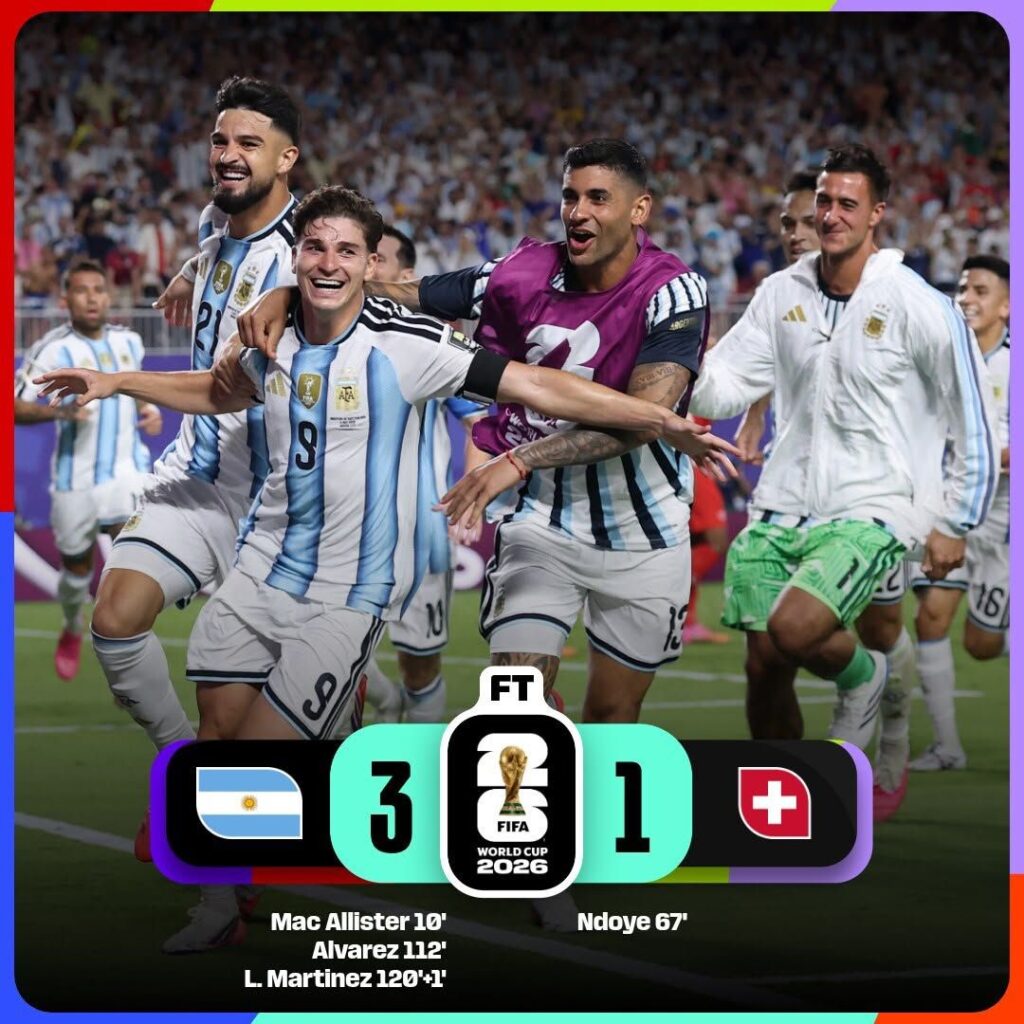
> “We came back against the world champions, we had the momentum, we were controlling the match, and then everything changed because of that decision. My boys are the real heroes.”
Midfielder Remo Freuler also questioned the VAR intervention, urging FIFA to clarify how such a decision was reached.
> “I don’t understand how VAR can make such a decision, and FIFA has to explain it to us.”
Embolo Red Card Embolo was visibly emotional after the dismissal, leaving the pitch in tears while being comforted by teammates. Yakin defended his striker, insisting he bore no responsibility for Switzerland’s elimination.
> “He was fouled many times during the game. I don’t blame him. He is devastated because he couldn’t help the team anymore. It was a refereeing mistake.”
Although Switzerland’s World Cup dream ended in heartbreaking fashion, Yakin praised his squad for achieving the nation’s best tournament performance since 1954 by reaching the quarter-finals.
Argentina now advances to the semi-finals, where the defending world champions will face England national football team in a blockbuster clash for a place in the 2026 FIFA World Cup final.Murat Yakin Blasts ‘Unacceptable’ Embolo Red Card After Switzerland’s World Cup Exit to Argentina
- Switzerland Aim to Contain Messi as Argentina Stand Between Them and World Cup History

Switzerland faces its toughest challenge yet as it prepares to stop Lionel Messi and Argentina in the 2026 FIFA World Cup quarterfinals. Granit Xhaka and Murat Yakin believe discipline and teamwork offer their best chance.
Danchimatv match preview Every generation of football has produced one question that opponents struggle to answer: how do you stop Lionel Messi?
As Switzerland prepares for a blockbuster FIFA World Cup quarterfinal against defending champions Argentina, that question once again dominates the conversation. Yet Swiss manager Murat Yakin insists there is no secret blueprint for containing the Argentine icon, only collective discipline and flawless execution.
Speaking ahead of the clash in Kansas City, Yakin smiled when asked how his side planned to deal with Messi’s influence.
“There are many possible solutions,” he said. “We’ll choose the one we believe gives us the best chance, but football is decided on the pitch. We have to defend together, press as a team and perform for the full 90 minutes.”
His caution is understandable. At 39, Messi continues to rewrite football history, delivering one of the greatest World Cup campaigns ever witnessed. The Argentina captain has already scored eight goals in five matches, proving that age has done little to diminish his brilliance as he leads La Albiceleste’s pursuit of another world title.
Messi’s impact was once again evident during Argentina’s dramatic Round of 16 victory over Egypt. After seeing an early penalty saved, the veteran forward responded with remarkable composure, creating Cristian Romero’s equaliser before finding the net himself minutes later. Enzo Fernández completed the stunning comeback in stoppage time, keeping Argentina’s championship dream alive and leaving an emotional Messi in tears after the final whistle.
Swiss captain Granit Xhaka knows better than most what it means to face Messi on football’s biggest stage. The midfielder was part of the Switzerland side eliminated by Argentina in the 2014 World Cup after Ángel Di María scored a heartbreaking extra-time winner from a Messi assist.
More than a decade later, Xhaka believes Switzerland has grown into a stronger and more confident team.
“I don’t think anyone can completely stop Messi for an entire match,” Xhaka admitted. “Our objective is to stay organised, remain compact and limit the spaces where he becomes most dangerous. When we have possession, we also need to make him defend and reduce his influence on the game.”
Switzerland arrives at the quarterfinal full of confidence after remaining unbeaten throughout the tournament. Four victories and a draw have underlined the team’s consistency, while a tense penalty shootout triumph over Colombia in the Round of 16 demonstrated both resilience and composure under pressure.
Argentina, however, has shown a different kind of strength. Lionel Scaloni’s side has repeatedly found ways to survive difficult moments, edging Cape Verde in extra time before producing another dramatic comeback against Egypt. Those performances have reinforced the mentality that has defined the reigning world champions—they continue fighting until the very last whistle.
For Switzerland, Saturday’s encounter represents an opportunity unlike any in the nation’s football history. A victory would secure the country’s first-ever appearance in a FIFA World Cup semifinal and rank among its greatest sporting achievements.
Xhaka believes belief must now be matched by courage.
“I’ve always believed that dreams can become reality,” he said. “But dreams only come true through hard work, sacrifice and pushing beyond your limits. If we want to eliminate Argentina, we must produce our very best performance.”
Standing in Switzerland’s way is a team inspired by perhaps the greatest player the sport has ever seen. If the Swiss are to make history, they must first accomplish what so many have failed to do over the past two decades—find a way to contain Lionel Messi when the stakes are at their highest.
- World Cup Hydration Break Ads Become a $250M Goldmine—Are They Here to Stay?

Mandatory hydration breaks at the 2026 FIFA World Cup are generating hundreds of millions in advertising revenue while drawing criticism from fans, players and managers. Here’s why they may be here to stay.
What began as a player welfare initiative has rapidly become one of the most profitable innovations in modern football broadcasting.
The mandatory hydration breaks introduced during the 2026 FIFA World Cup are now generating an estimated more than $250 million in advertising revenue in the United States alone, transforming a three-minute pause into a lucrative commercial opportunity.
For many supporters inside stadiums and watching around the world, however, the breaks have become one of the tournament’s most controversial talking points.
Millions Generated From Three-Minute Breaks
Each World Cup match includes two mandatory hydration breaks—one midway through each half.
Broadcasters are allowed to begin commercials 20 seconds after play stops and must return 30 seconds before kick-off resumes, creating enough time for up to eight additional 30-second advertisements per match.
Industry experts estimate that a single 30-second commercial during World Cup broadcasts on Fox Sports costs between $200,000 and $300,000, with premium matches involving the United States or the knockout rounds reaching as much as $750,000 per slot.
Across the tournament, those figures translate into more than $250 million in additional advertising revenue in the American market.
Globally, analysts believe hydration break advertising could surpass $1 billion.
Fans Voice Their Frustration
While broadcasters celebrate the new revenue stream, many supporters have reacted very differently.
Hydration breaks have frequently been met with loud boos inside stadiums, with critics arguing that they interrupt the flow of matches and reduce football’s continuous nature.
Managers and players have also questioned whether the stoppages are necessary in matches played inside air-conditioned stadiums or during relatively mild conditions.
USA head coach Mauricio Pochettino described many of the breaks as unnecessary except during extreme heat.
Different Viewing Experiences Around the World
The experience depends heavily on where supporters are watching.
Fans in the United Kingdom continue to watch tactical analysis and live stadium coverage during hydration breaks because broadcasting regulations limit the use of advertisements during active play.
In contrast, viewers in countries including the United States, Germany, France, Spain, Italy, Canada, Mexico, China, Japan, India, Australia, the Middle East, and Sub-Saharan Africa are often shown full-screen commercials or split-screen advertisements.
Some broadcasters have even secured sponsors specifically for the hydration breaks themselves, creating another layer of commercial branding.
A Financial Win for FIFA
Although FIFA does not directly receive advertising revenue from the breaks, experts believe the additional income significantly increases the value of future television rights.
If broadcasters can generate hundreds of millions of dollars through extra advertising inventory, FIFA will likely demand higher rights fees for future tournaments.
With the 2030 FIFA World Cup scheduled to be hosted by Morocco, Spain and Portugal, where summer temperatures can also be extremely high, many analysts believe hydration breaks are unlikely to disappear.
“There is never any going back when there is an opportunity to make more money,” one sports media expert noted.
Could Club Football Follow?
Despite the financial appeal, experts remain skeptical that domestic competitions such as the Premier League or UEFA Champions League will introduce similar commercial breaks.
Traditional football audiences are generally less accepting of interruptions, and broadcasters in several markets remain subject to strict advertising regulations.
UEFA has already confirmed it has no plans to introduce hydration-break advertising in its competitions, including the Champions League and Euro 2028.
The Bigger Picture
The debate surrounding hydration breaks reflects football’s ongoing struggle to balance tradition with commercial growth.
For broadcasters and advertisers, the pauses represent a billion-dollar opportunity.
For many supporters, they symbolize another step toward the commercialization of the world’s most popular sport.
Whether fans like them or not, hydration-break advertisements appear set to remain a major part of FIFA tournaments for years to come.