|
Getting your Trinity Audio player ready...
|
What Are DeFi Liquidations?
DeFi liquidations occur when the deposited collateral’s value falls below a certain threshold of the debt value. When this happens, the borrower’s position will be considered undercollateralized and the collateral will be liquidated.
Key Takeaways
- Lending platforms let borrowers use their cryptocurrency assets as collateral to borrow other assets from the protocol, and DeFi loans are usually overcollateralized.
- When the deposited collateral’s value falls below a certain level and the loan is not repaid, the deposited collateral will be liquidated.
- Borrowers and lenders can use tools like Block Analitica to analyze risk management in DeFi.
Decentralized finance was once a ‘safe haven’ for users who wanted to earn interest on their cryptocurrency assets, as opposed to the meager returns that traditional finance had to offer. However, these relatively new ways of putting your money to work aren’t always safe, and interest accrued over time can be lost in the blink of an eye. In this article, we’ll explore how liquidation events work in DeFi, and learn more about how to avoid them and monitor them live.
DeFi Lending in a Nutshell
To fully grasp how liquidations function, it’s first essential to revisit and comprehend the fundamentals of using lending protocols such as the well-known Aave, MakerDAO, and Compound which allow users to borrow and lend funds.

Most Popular Lending Platforms
These lending platforms enable borrowers to use their own cryptocurrency assets as collateral to borrow other assets provided by the chosen protocol. The borrower’s collateral, which can range from extremely volatile to relatively stable cryptocurrencies, is deposited on the platform and locked in smart contracts, as a security measure in the event that the loan cannot be repaid.
Overcollateralization
To borrow cryptocurrency, the individual wishing to borrow (the borrower) must deposit a crypto asset of their choice that is worth more than the amount they wish to borrow. This is known as overcollateralization.
In other words, users must deposit more collateral than the amount they want to borrow. This ensures that if circumstances take a turn for the worse, the excess value will provide a substantial buffer to protect lenders against borrower defaults.
How DeFi Liquidations Happen
DeFi liquidations occur when the value of the collateralized assets drops beyond a certain threshold. When the value of the collateralized assets starts falling, the borrower may run into difficulties and could become unable to provide enough collateral to continue keeping their decentralized loan open, and once this happens, the deposited collateral will be liquidated.
“If the value of the deposited collateral falls below a certain level and the loan is not repaid, the corresponding account will be liquidated.”
How a liquidation works will depend on how DeFi protocols use smart contracts. The liquidation event is done by the liquidation engine that runs on the code of smart contracts. This ensures not only the solvency of the protocol but also that the lender’s funds are at all times protected and the borrower’s outstanding debt is repaid in full.
For example, the smart contract might sell the collateral for the borrowed asset at current market prices. This sale would then be used to repay the lender, and if luck is on the side of the borrower, any remaining funds would be returned to the borrower who was liquidated.
Decentralized Liquidations in History
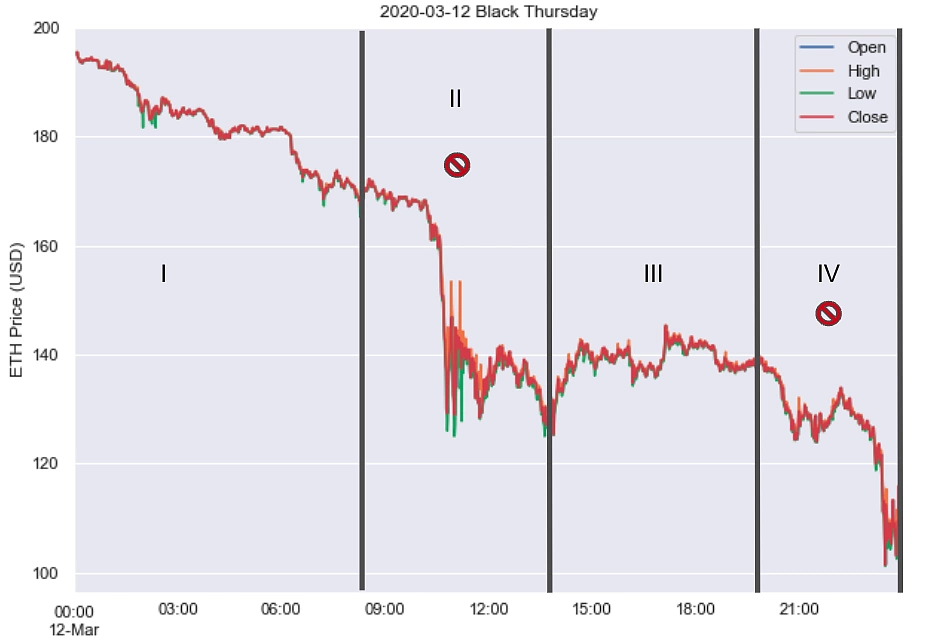
When we look at the several biggest liquidations that happened through the course of decentralized finance history, we see the largest price drop, which was 48.11% on a single day, (March 12, 2020).
The day that later became known as Black Thursday, which essentially permanently REKT many DeFi users, never to return again. This black swan event, in reaction to the COVID-19 news (seen below) led to sizable forced liquidations across centralized exchanges as well as DeFi lending markets.
Other Liquidation Events
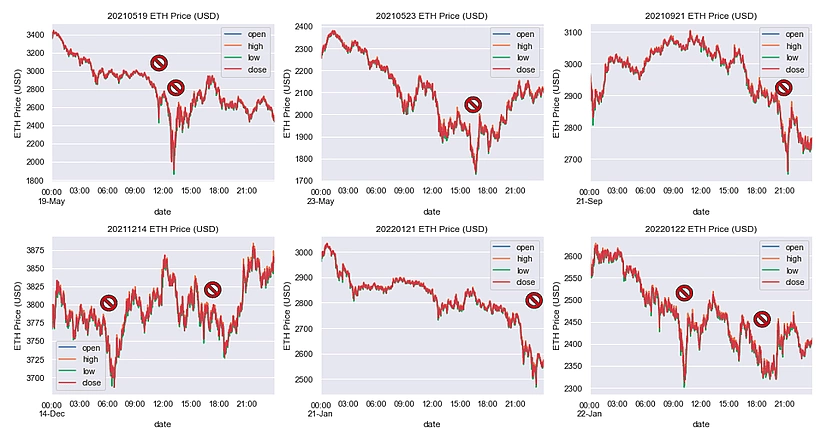
But as we already know, crypto has more black swan events than any other industry and looking back, ‘Black Thursday’ wasn’t the only fat-tail event that could be observed and which had a significant impact on the portfolio, positions and mood of DeFi users.
Other Liquidation Events – Black Swans
The charts above illustrate the historical price behavior and market corrections in relation to several significant events: the May 2021 flash crash driven by China FUD and environmental concerns; SEC FUD in September 2021; reaction to the emergence of the Omicron variant in December 2021; the Wall Street crash and declines in the Nasdaq index in January 2022; and further price drops on January 22nd associated with rising interest rates and tighter monetary policy by the Federal Reserve which contributed to a more risk-off sentiment.
These frequent portfolio destroying events force us to understand why you should always remain cautious using DeFi, serving as a cautionary tale of the risk of decentralized finance.
The Importance of Monitoring DeFi Liquidations
Now that we know how liquidations occur and that liquidations in DeFi can happen more often than one should like, we can shift our understanding to focus on position and risk management to avoid liquidations.
This is especially important if you are a borrower who must maintain sufficient collateral value to prevent unwanted liquidation events. But also on the flip side, it can be crucial for a lender who can monitor their borrowers’ collateral values to ensure they themselves leave nothing to luck, and try to act prudently whenever necessary.
Even if you are not involved in decentralized lending and have so to speak, no ‘skin in the game’, you can always choose to observe from the sidelines and gain insights on how others manage their risk and positions. This is a perfect way to get more familiar with DeFi and understanding the DeFi market.
How to Monitor DeFi Liquidations With Block Analitica
Block Analitica is a risk management firm that leverages the open transaction transparency of Ethereum and computational techniques like simulation modeling and machine learning to gather actionable intelligence, which is perfectly suited to analyze risk and position management in decentralized finance.
Let’s explore these tools, all made by Block Analitica, and use them to get a behind-the-scenes look at how lending and borrowing work in DeFi protocols.
MakerDAO Analytics: Liquidations Dashboard
The first tool is a monitoring service fully focused on the lending platform MakerDao. On the MakerDAO Analytics tool we find the following information: active liquidation in the dashboard, past liquidations and some interesting metrics.
The Maker auction system introduced in May 2021 has successfully liquidated 2,255 positions, which refers to the total number of times the protocol has had to seize collateral due to borrowers failing to maintain their necessary collatera