|
Getting your Trinity Audio player ready...
|
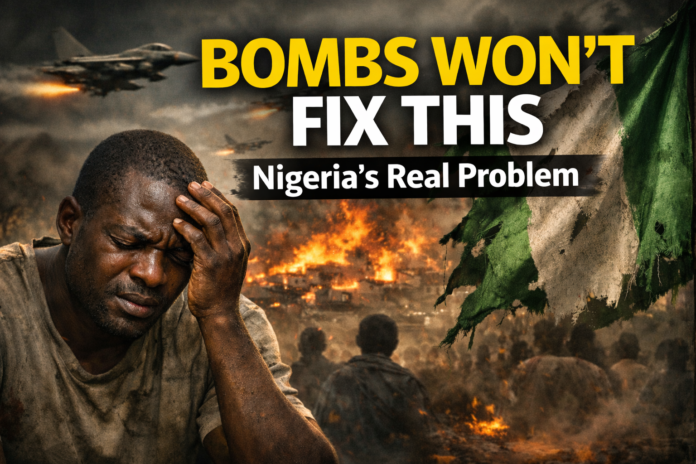
The Federal Government’s acknowledgement of intelligence cooperation with the United States—particularly around possible airstrikes against terrorist groups—should concern every Nigerian who understands the true nature of the country’s insecurity crisis.
Nigeria’s security problem is not religious.
It is a governance failure.
For years, armed groups have ravaged communities, displaced millions, and steadily weakened national unity. Throughout this period, intelligence reports, investigative journalism, and public allegations have repeatedly pointed to influential individuals—both within and outside government—who allegedly sponsor, finance, arm, or facilitate terrorism, often through cross-border networks from the Sahel. Yet the Nigerian state has consistently failed, or refused, to arrest, prosecute, and secure convictions against these powerful actors.
That failure lies at the heart of Nigeria’s insecurity.
Rather than enforce the law against those at the top, the government has chosen the path of least resistance: disarming ordinary citizens, restricting lawful self-defence, and leaving vulnerable communities exposed to violent attacks. A state that denies its people the right to protect themselves, while shielding alleged sponsors of terror, has effectively abandoned its constitutional duty.
It is against this backdrop that foreign military involvement is now being presented as a solution. It is not.
Nigeria does not need the United States, Israel, or any foreign power to secure its territory. History clearly shows that external military intervention rarely cures internal governance failures. Afghanistan was “secured” and later handed back to the Taliban. Iraq was “liberated” and left deeply fractured. Libya was “saved” through foreign intervention; Muammar Gaddafi was killed, and the state collapsed into chaos. Syria today is controlled by actors once labelled terrorists, now selectively legitimised by foreign interests.
These are not success stories. They are cautionary tales.
It is therefore misleading—and dangerous—to frame foreign involvement as an effort to protect Christians or to wage war against Islam in Nigeria. Leaders such as Donald Trump and Benjamin Netanyahu presided over unresolved conflicts and serious human rights concerns within their own spheres. They cannot credibly present themselves as guardians of Nigerian lives.
Even more troubling is the risk that foreign intervention will recast Nigeria’s crisis as a religious war. Nigeria’s insecurity is not Christianity versus Islam. It is impunity versus justice. It is elite protection versus accountability.
If Nigeria allows this crisis to be reframed along religious lines, the consequences will be devastating. Such a conflict will not be confined to forests and remote areas. It will engulf cities, towns, villages, and homes—tearing the country apart in ways that may be impossible to reverse.
Nigeria does not need foreign bombs.
Nigeria needs effective law enforcement.
Nigeria needs arrests, prosecutions, and convictions of terror sponsors—no matter how highly placed they may be.
Above all, Nigeria needs a government willing to apply the law without fear or favour.
Until justice is enforced, no intelligence sharing, no airstrike, and no foreign partnership will deliver peace.
Security without justice is nothing more than an illusion.
US airstrikes missed target, missiles hit empty field – Ex-FRCN DG Salihu

On December 25, the US carried out several airstrikes aimed at ISIS fighters in Sokoto, located in north-west Nigeria.
The US Africa Command, AFRICOM, later explained on X that the operation was carried out with the collaboration of the Nigerian government.
AFRICOM said the attack showed the strength of the US military and its determination to stop terrorist threats both within the US and in other countries.
However, Salihu shared a different account in a post on X, saying he personally spoke with Bashar Isah Jabo, a member of the Sokoto State House of Assembly, who visited the affected area shortly after the strike.
According to the lawmaker, the missiles fell on an open field about 300 meters away from a local hospital. No one was injured or killed in the incident.
Salihu added that Jabo village had not experienced any terrorist activity or ISWAP presence throughout 2025. He said there were also no records of farmer-herder conflicts in the area.
He explained that villagers only found missile fragments near a large crater, with no damage to homes or loss of life.
Salihu questioned the purpose of the strike and wondered if it was meant to make headlines rather than eliminate real threats.
While supporting cooperation to fight terrorism, he said attacks should focus on known terrorist leaders and strongholds.
He called on Nigeria’s Defence Headquarters to investigate the incident and provide a clear report to the public.
Salihu also expressed relief that the missiles did not hit the hospital or harm innocent residents of Jabo village.
“I just spoke with Hon Sarkin Yaki Jabo Member Sokoto State Assembly who visited Jabo after the strike at 10:30pm last night. The US strike in Jabo near Tambuwal wasn’t a precision strike. No casualties. Missiles landed in a plain field 300metres away from a Local Hospital,” he said.
888starz. https://888-uz7.com/
888staz https://888-uz5.com/
You made some really good points there. I looked on the internet for more info about the issue and found most people will go along with your views on this site.
It’s very simple to find out any matter on web as compared to textbooks, as I found this paragraph at this web page.
Greetings! Very helpful advice within this article! It’s the little changes which will make the largest changes. Many thanks for sharing!
Hi Dear, are you truly visiting this web site on a regular basis, if so after that you will absolutely take good knowledge.
I will immediately grab your rss feed as I can’t to find your e-mail subscription link or newsletter service. Do you’ve any? Please allow me recognise so that I could subscribe. Thanks.
Hi! I’ve been following your blog for a while now and finally got the courage to go ahead and give you a shout out from Houston Texas! Just wanted to say keep up the good job!
I love it when people get together and share ideas. Great website, continue the good work!
Ahaa, its pleasant dialogue regarding this article at this place at this webpage, I have read all that, so now me also commenting at this place.
I like what you guys are up too. This kind of clever work and exposure! Keep up the good works guys I’ve incorporated you guys to my own blogroll.
Hi there, I log on to your blog like every week. Your humoristic style is awesome, keep doing what you’re doing!
I like it whenever people come together and share thoughts. Great blog, continue the good work!
Ahaa, its fastidious discussion about this post at this place at this web site, I have read all that, so at this time me also commenting at this place.
I visited many web pages however the audio feature for audio songs present at this web page is genuinely excellent.
Казино Водка официальный сайт и рабочее зеркало, бонусы для новых игроков
Зеркала обычно поддерживают тот же набор языков и настроек профиля.
I like what you guys are up also. Such clever work and reporting! Keep up the superb works guys I’ve incorporated you guys to my blogroll. I think it’ll improve the value of my site :).
These are actually fantastic ideas in about blogging. You have touched some nice points here. Any way keep up wrinting.