


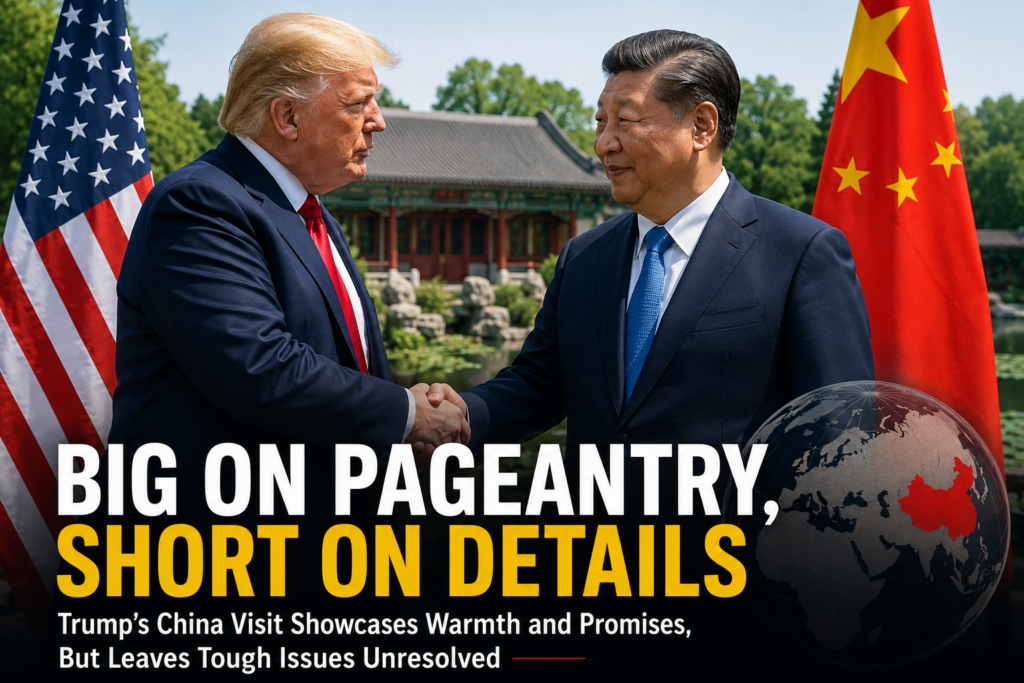
President Donald Trump has wrapped up his latest trip to China describing the visit as “incredible,” but behind the elaborate ceremonies and carefully choreographed diplomacy, many of the major outcomes remain uncertain.
The two-day visit to Beijing was filled with symbolism, state banquets, military honors and private meetings with Chinese President Xi Jinping. Yet despite the public display of warmth between the two leaders, there were few concrete agreements formally announced by either government.
Trump claimed the trip produced major business opportunities for American companies and farmers, pointing specifically to potential soybean purchases and a large aircraft order involving Boeing. According to Trump, China could buy as many as 200 aircraft, though even he appeared uncertain whether the understanding amounted to a finalized commitment.
Advertisement
Beijing has not officially confirmed the purchases.
That uncertainty reflects a familiar pattern in U.S.-China diplomacy under Trump. Grand announcements often arrive before the details are fully negotiated, leaving analysts and markets waiting to see whether political theater eventually transforms into enforceable agreements.
Still, both sides appear eager to stabilize relations after years of escalating tariffs, economic rivalry and military tension. For China, the importance of the visit may have been less about immediate trade results and more about restoring communication channels between the world’s two largest economies.
Chinese officials emphasized long-term stability throughout the meetings. Xi reportedly warned Trump that mishandling the issue of Taiwan could seriously damage bilateral ties. Beijing continues to view Taiwan as a non-negotiable national issue and remains deeply sensitive to any American involvement on the island.



The American side largely avoided publicly engaging that topic during the trip, although U.S. Secretary of State Marco Rubio later reiterated that Washington’s Taiwan policy remains unchanged and warned against any attempt to seize the island by force.
Beyond trade and geopolitics, the visit highlighted the striking contrast between Trump’s personal diplomatic style and China’s more calculated statecraft.
Trump repeatedly praised Xi in public, complimenting both his appearance and leadership style while stressing the importance of personal chemistry between leaders. Xi, meanwhile, maintained a more reserved posture, focusing less on personal admiration and more on the strategic relationship between both nations.
That difference in style became symbolic of the broader relationship itself. Trump approaches diplomacy as a negotiation driven by personalities and instincts. China, on the other hand, operates through long-term planning, institutional messaging and carefully managed symbolism.
And symbolism was everywhere during the visit.
Trump was welcomed with lavish ceremonies, youth performances, military displays and a rare invitation into Zhongnanhai, the leadership compound typically closed to foreign dignitaries. Chinese officials clearly understood the value Trump places on pageantry and spectacle, and Beijing used that understanding effectively.
The imagery alone sent a message: despite rising tensions and global uncertainty, both nations are still willing to engage directly at the highest level.
The leaders even toured the gardens at Zhongnanhai together, where Trump reportedly admired the roses and Xi promised to send Chinese rose seeds to be planted at the White House Rose Garden. Small gestures like these may seem insignificant, but in diplomacy they often serve as signals of openness and mutual respect.
Yet behind the smiles and ceremonial handshakes, difficult realities remain unresolved.
The United States and China are still locked in intense competition over trade, technology, military influence and global leadership. Differences over Taiwan, the South China Sea, semiconductor exports and economic security continue to threaten the fragile relationship.
For now, this visit may be remembered less for what was signed and more for what it attempted to prevent — a further collapse in communication between Washington and Beijing.
Whether the warmth displayed in Beijing leads to meaningful progress or simply delays future confrontation remains an open question.