


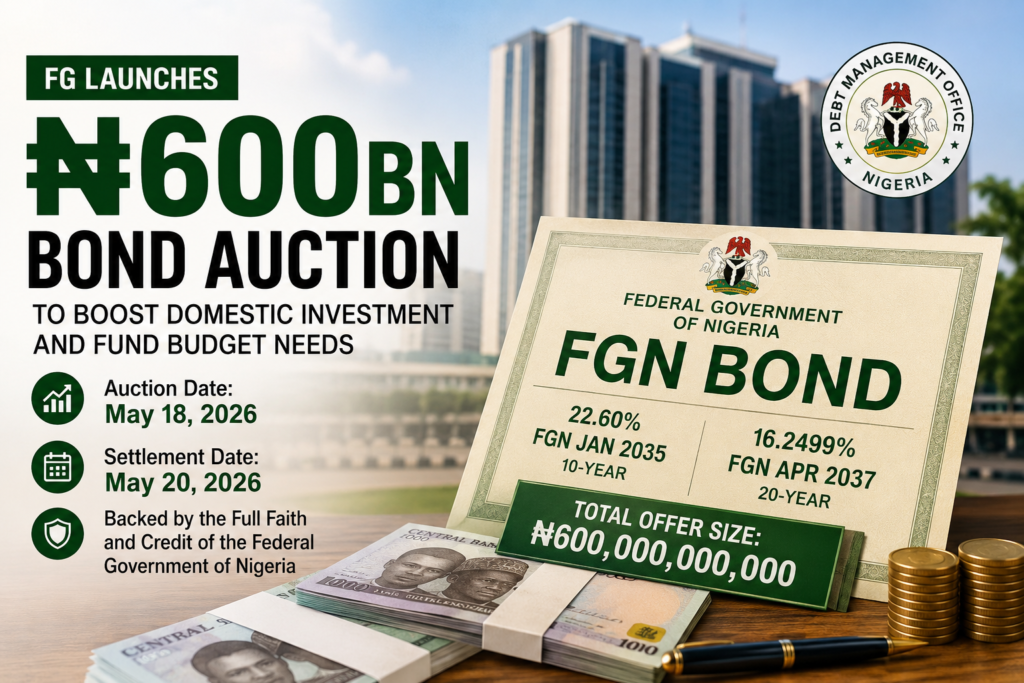
The Federal Government of Nigeria has launched a fresh ₦600 billion bond auction aimed at attracting domestic investors and strengthening the country’s local debt market as authorities continue efforts to finance national obligations without increasing exposure to foreign currency risks.
According to details released by the Debt Management Office (DMO), the Federal Government bond auction is scheduled to take place on May 18, 2026, while settlement for successful investors will occur on May 20, 2026.
Two Re-Opened FGN Bonds Offered
The DMO disclosed that the offer consists of two re-opened Fed⁵eral Government of Nigeria (FGN) bond instruments valued at ₦300 billion each.
The instruments include:
22.60% FGN January 2035 Bond (10-year re-opening)
16.2499% FGN April 2037 Bond (20-year re-opening)
Both bonds are being offered at ₦1,000 per unit, with a minimum subscription threshold of ₦50.001 million. Additional subscriptions can be made in multiples of ₦1,000.
Because the bonds are re-openings of previously issued instruments, the coupon rates remain unchanged.
Interest Payments and Maturity Structure
The DMO stated that investors will receive interest payments twice yearly throughout the lifespan of the bonds.
Repayment of the principal will follow a bullet repayment structure, meaning the full principal amount will be paid back upon maturity.
Successful bidders are expected to pay based on the yield-to-maturity rate that clears the auction, alongside accrued interest.
The agency emphasized that the bonds are fully backed by the faith and credit of the Federal Government, positioning them among the safest fixed-income investment instruments in Nigeria’s domestic market.


Government Continues Domestic Borrowing Strategy
The latest bond issuance highlights the Federal Government’s continued dependence on domestic borrowing to finance budget deficits, refinance existing debt obligations, and support infrastructure development projects.
Economic analysts believe the strategy also helps reduce risks linked to foreign exchange volatility and external debt exposure.
However, findings show the government slightly reduced the size of the May 2026 offer compared to April 2026, when ₦700 billion worth of bonds were offered across three instruments.
Market observers say the reduction could indicate a more cautious borrowing approach amid concerns over rising debt servicing costs, despite improved oil prices and stronger liquidity conditions offering some fiscal relief.




Tax Incentives for Investors
To encourage participation from institutional investors, the DMO highlighted several incentives attached to the bond offer.
According to the agency, the bonds qualify as trustee investment securities under the Trustee Investment Act and also qualify as government securities under both the Company Income Tax Act (CITA) and the Personal Income Tax Act (PITA).
Eligible investors, including pension fund operators, may benefit from tax exemptions tied to the instruments.
The bonds are also listed on the Nigerian Exchange Limited and the FMDQ OTC Securities Exchange, allowing investors to trade them on the secondary market.
In addition, banks can classify the bonds as liquid assets when calculating liquidity ratios.
Approved Banks for Bond Applications
Interested investors have been advised to submit applications through approved Primary Dealer Market Makers (PDMMs), including major financial institutions such as:
Access Bank Plc
First Bank of Nigeria
Stanbic IBTC Bank
Guaranty Trust Bank
United Bank for Africa
Zenith Bank Plc
Ecobank Nigeria
Standard Chartered Bank Nigeria
What the Bond Offer Means for Investors
Financial experts say the new FGN bond issuance could attract strong interest from pension funds, institutional investors, and high-net-worth individuals seeking relatively stable long-term investment options amid market uncertainty.
The move also signals the government’s commitment to sustaining local financing channels while balancing rising debt obligations and economic recovery efforts.
In Other News
- (no title)
 Spread the love Cristiano Ronaldo: “I decided to leave the camp without waiting for any further breach of word. For me the truth is still the most important thing… Read more: (no title)
 - Everyone Rooted for the Rise. Now They Want the Fall.
 Spread the love Manchester City have been found guilty on 114 of 115 Premier League charges. The independent commission’s decision, reported on Friday, lands like a long-delayed verdict after… Read more: Everyone Rooted for the Rise. Now They Want the Fall.
 - Trump Shuts CNN, Politico and MSNOW Out of the White House
 Trump announced Friday that CNN, Politico and MSNOW are barred from the White House over what he called “FAKE NEWS,” warning more outlets could follow. He also accused Politico of receiving an “illegal” $8 million subscription under Biden.
 - Vance Backs White House Press Restrictions, Calls Targeted Outlets “Propaganda” MachinesVice President JD Vance defended the Trump administration’s decision to bar CNN, MS NOW and Politico from the White House, arguing that outlets engaged in what he called “far left propaganda” shouldn’t expect special access from a Republican administration. The three outlets have sued, citing First Amendment concerns.
- Spurs, Chelsea and Fulham RELEGATED? Our Shock 2026-27 Premier League Prediction Will Split the Nation
 Could Chelsea, Tottenham and Fulham really be heading for relegation? It sounds outrageous — especially with Chelsea currently sitting comfortably outside the bottom three. But early-season results are already raising questions. Danchima Media makes its bold 2026/27 Premier League prediction, with Manchester City tipped for the title and three London clubs facing a dramatic fight for survival.
