


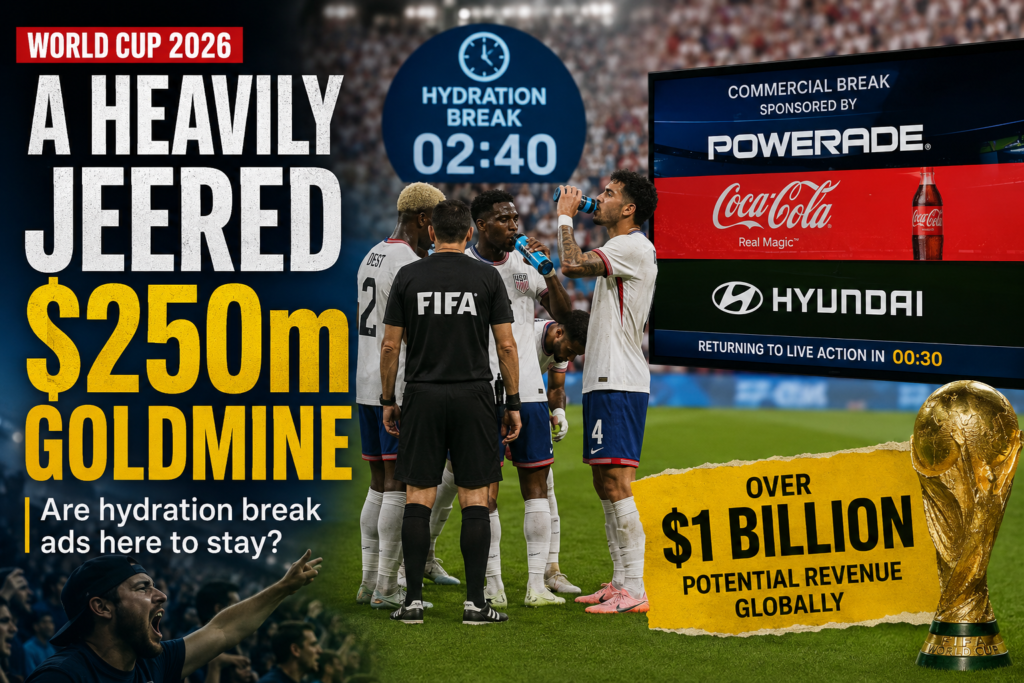
Mandatory hydration breaks at the 2026 FIFA World Cup are generating hundreds of millions in advertising revenue while drawing criticism from fans, players and managers. Here’s why they may be here to stay.
What began as a player welfare initiative has rapidly become one of the most profitable innovations in modern football broadcasting.
The mandatory hydration breaks introduced during the 2026 FIFA World Cup are now generating an estimated more than $250 million in advertising revenue in the United States alone, transforming a three-minute pause into a lucrative commercial opportunity.
For many supporters inside stadiums and watching around the world, however, the breaks have become one of the tournament’s most controversial talking points.
Millions Generated From Three-Minute Breaks
Each World Cup match includes two mandatory hydration breaks—one midway through each half.
Broadcasters are allowed to begin commercials 20 seconds after play stops and must return 30 seconds before kick-off resumes, creating enough time for up to eight additional 30-second advertisements per match.
Industry experts estimate that a single 30-second commercial during World Cup broadcasts on Fox Sports costs between $200,000 and $300,000, with premium matches involving the United States or the knockout rounds reaching as much as $750,000 per slot.
Across the tournament, those figures translate into more than $250 million in additional advertising revenue in the American market.
Globally, analysts believe hydration break advertising could surpass $1 billion.
Fans Voice Their Frustration
While broadcasters celebrate the new revenue stream, many supporters have reacted very differently.
Hydration breaks have frequently been met with loud boos inside stadiums, with critics arguing that they interrupt the flow of matches and reduce football’s continuous nature.
Managers and players have also questioned whether the stoppages are necessary in matches played inside air-conditioned stadiums or during relatively mild conditions.
USA head coach Mauricio Pochettino described many of the breaks as unnecessary except during extreme heat.

Different Viewing Experiences Around the World
The experience depends heavily on where supporters are watching.
Fans in the United Kingdom continue to watch tactical analysis and live stadium coverage during hydration breaks because broadcasting regulations limit the use of advertisements during active play.
In contrast, viewers in countries including the United States, Germany, France, Spain, Italy, Canada, Mexico, China, Japan, India, Australia, the Middle East, and Sub-Saharan Africa are often shown full-screen commercials or split-screen advertisements.
Some broadcasters have even secured sponsors specifically for the hydration breaks themselves, creating another layer of commercial branding.
A Financial Win for FIFA
Although FIFA does not directly receive advertising revenue from the breaks, experts believe the additional income significantly increases the value of future television rights.
If broadcasters can generate hundreds of millions of dollars through extra advertising inventory, FIFA will likely demand higher rights fees for future tournaments.
With the 2030 FIFA World Cup scheduled to be hosted by Morocco, Spain and Portugal, where summer temperatures can also be extremely high, many analysts believe hydration breaks are unlikely to disappear.
“There is never any going back when there is an opportunity to make more money,” one sports media expert noted.


Could Club Football Follow?
Despite the financial appeal, experts remain skeptical that domestic competitions such as the Premier League or UEFA Champions League will introduce similar commercial breaks.
Traditional football audiences are generally less accepting of interruptions, and broadcasters in several markets remain subject to strict advertising regulations.
UEFA has already confirmed it has no plans to introduce hydration-break advertising in its competitions, including the Champions League and Euro 2028.
The Bigger Picture
The debate surrounding hydration breaks reflects football’s ongoing struggle to balance tradition with commercial growth.
For broadcasters and advertisers, the pauses represent a billion-dollar opportunity.
For many supporters, they symbolize another step toward the commercialization of the world’s most popular sport.
Whether fans like them or not, hydration-break advertisements appear set to remain a major part of FIFA tournaments for years to come.