


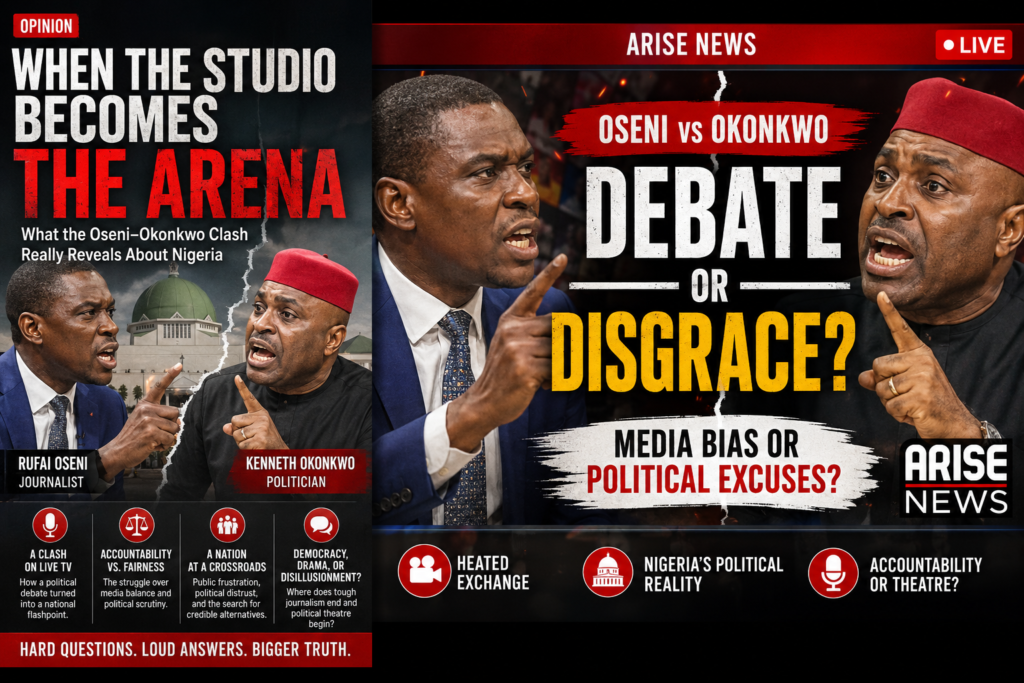
The recent live exchange between journalist Rufai Oseni and politician Kenneth Okonkwo on Arise News was more than just another heated television moment. It was a public display of a deeper strain running through Nigeria’s political and media ecosystem — one where frustration, mistrust, and competing truths are increasingly expressed in real time, without restraint.
At face value, the confrontation began with a pointed criticism of the opposition’s preparedness. Oseni’s remarks questioning the strength and coherence of an emerging political coalition immediately set the tone for tension. Okonkwo’s reaction was swift and forceful, rejecting what he perceived as a dismissive framing and turning the spotlight back onto the media itself, accusing it of failing to apply consistent scrutiny to those in power.
What unfolded was not a structured debate but a collision of narratives — one side insisting on political accountability through tough questioning, the other insisting on fairness and equal treatment in public discourse. In that moment, the studio stopped being a neutral space for analysis and became a stage where deeper grievances about Nigeria’s democracy were aired without filter.

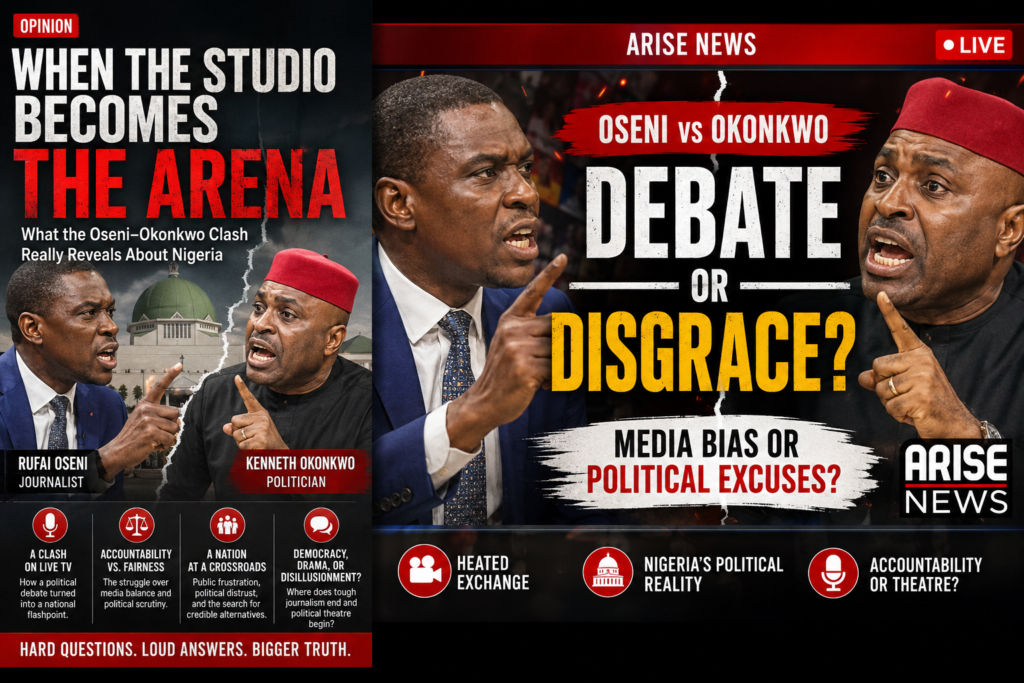
But reducing the incident to a “shouting match” misses the more important point. This kind of exchange is becoming increasingly common because the underlying tensions it reflects are unresolved. The public is growing impatient with political promises that feel distant from lived reality, while opposition voices argue that they are often undermined before they can fully establish credibility. The media, positioned between both, is now expected not only to report but to interrogate — sometimes aggressively — while also being accused of bias depending on who feels targeted.
This creates a difficult paradox for adversarial journalism. When journalists challenge political actors strongly, they are praised by some for holding power to account and criticized by others for overstepping into confrontation. Yet when questioning is softened, they are accused of complicity or lack of rigor. The result is a media environment where intensity is almost inevitable, because anything less risks being seen as insufficient.


Still, there is a fine line between accountability journalism and performative confrontation. The danger is that public discourse begins to prioritize spectacle over substance, where the loudest exchanges are mistaken for the most meaningful insights. In such an environment, audiences may become more entertained than informed, even as they believe they are witnessing transparency in action.
What this moment ultimately exposes is not just a disagreement between two individuals, but a wider credibility gap — between political institutions struggling to earn trust, media organizations navigating their role in an increasingly polarized space, and citizens who are demanding change but remain uncertain about where it will come from.


Whether one sees the Oseni–Okonkwo clash as healthy democratic friction or as evidence of a system under strain, it reflects a truth that can no longer be ignored: Nigerian public discourse is evolving into something more immediate, more emotional, and more confrontational.
The question now is not whether such moments will continue — they will — but whether they will lead to greater clarity and accountability, or simply become another form of political theatre in a nation still searching for stable ground.