

Football has always belonged to the people.
From dusty pitches in Africa to packed stadiums in Europe, from neighbourhood viewing centres in South America to public squares in Asia, the game has earned its title as the world’s sport because it transcends wealth, language, politics, and geography.
Yet as the 2026 FIFA World Cup approaches, a troubling question is emerging from host cities across the United States, Canada, and Mexico:
Who is this World Cup really for?
The voices coming from Atlanta, Los Angeles, Mexico City, San Francisco, Philadelphia, and many other host cities tell a remarkably similar story. Excitement remains. Passion for football remains. The dream of witnessing the world’s greatest tournament remains.


What is disappearing is accessibility.
For many supporters, attending a World Cup match in their own city has become financially impossible. Families who waited years for this opportunity are discovering that a single match can cost hundreds or even thousands of dollars. Lifelong fans are being forced to watch from home while premium packages, corporate hospitality suites, and VIP experiences dominate the conversation.
Football’s biggest celebration is increasingly beginning to resemble an exclusive event.
That should concern everyone who loves the game.
The World Cup has always been more than a tournament. It is a cultural festival where supporters from different nations eat together, sing together, celebrate together, and occasionally cry together. The atmosphere created by ordinary fans is what transforms a football competition into a global phenomenon.
Remove those supporters and something essential is lost.
What makes the concerns of fans even more significant is that they extend beyond ticket prices. Across all three host nations, many supporters are questioning whether local communities will enjoy lasting benefits from hosting the tournament.
World Cups have often been sold as opportunities to improve infrastructure, boost tourism, and leave a positive legacy. Yet many residents believe those promises have not materialized. In some cities, transportation concerns remain unresolved. In others, public enthusiasm appears surprisingly muted despite the tournament being just around the corner.
The danger is that organizers become so focused on delivering a successful commercial event that they overlook the people whose passion gives football its value in the first place.
This is not an argument against profit. Major sporting events require enormous investment, and organizers deserve a return. But there must be a balance between commercial success and fan inclusion.
Without that balance, football risks becoming disconnected from the communities that built it.
The irony is that the 2026 World Cup has the potential to be one of the greatest tournaments ever staged. It will feature more nations, more matches, and more opportunities for cultural exchange than any World Cup in history. It could introduce millions of new fans to the sport and strengthen football’s growing presence in North America.
But greatness is measured by more than attendance figures, television ratings, or sponsorship revenue.
Greatness is measured by memories.
The child attending a first World Cup match with their parents.
The supporter travelling across continents to follow their national team.
The friendships formed between strangers united by a shared love of the game.
Those are the moments that define a World Cup.

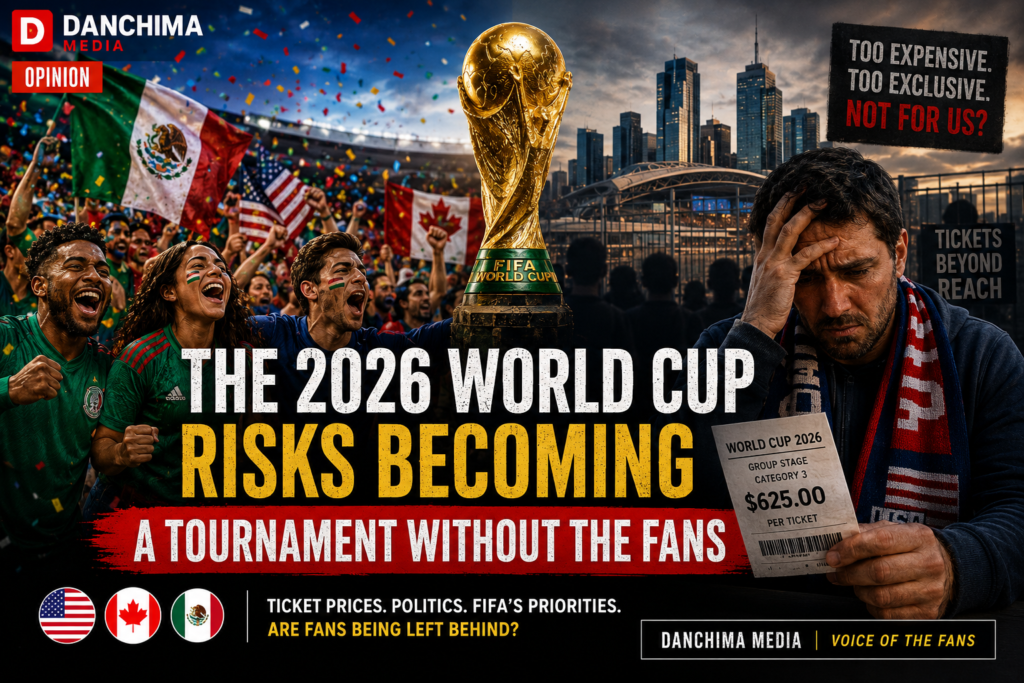
As kickoff approaches, FIFA and local organizers still have an opportunity to listen to supporters and ensure that football’s greatest tournament remains connected to the people who made it great.
Because the World Cup without the fans is not truly a World Cup at all.
— Danchima Media Sports