


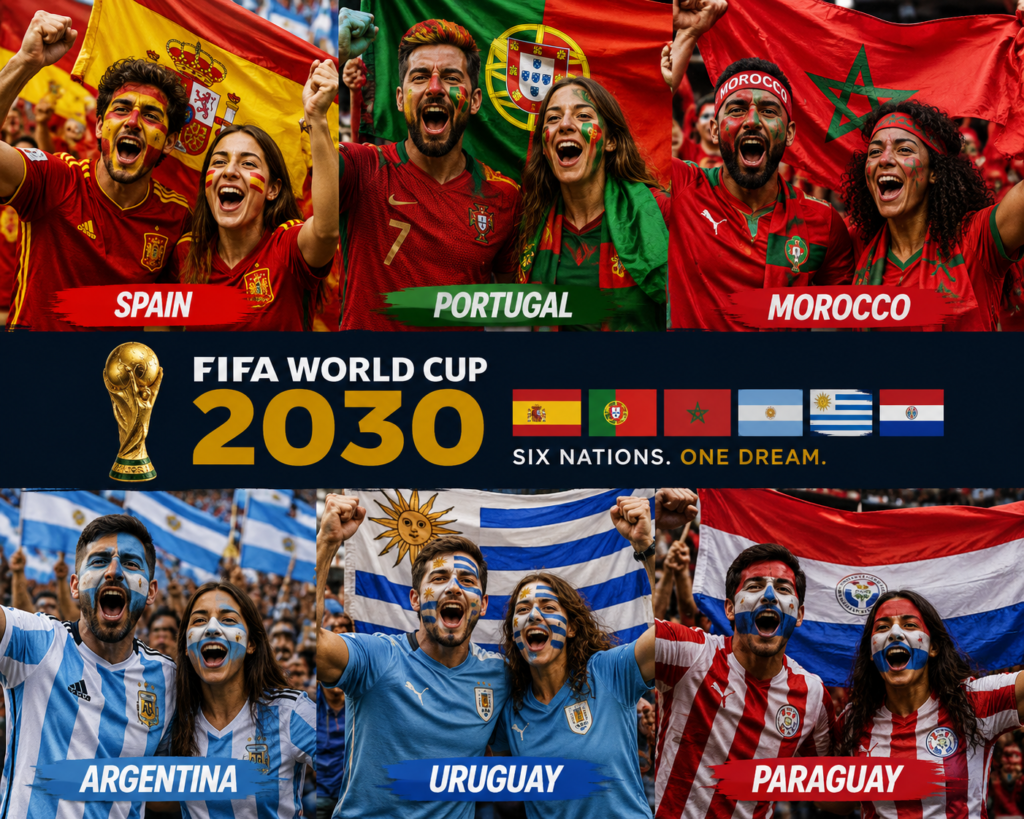
The FIFA World Cup is set to enter a new era in 2030 as football’s biggest tournament celebrates its 100th anniversary with an unprecedented format spanning six host nations across three continents.
The milestone edition will combine history with innovation, as South America hosts the opening centenary fixtures before the tournament shifts to its primary hosts in Europe and Africa.
A World Cup Like No Other
The 2030 FIFA World Cup will be jointly hosted by Spain, Portugal and Morocco, while Uruguay, Argentina and Paraguay will each stage a special opening-round match to commemorate the centenary of the inaugural FIFA World Cup, which was held in Uruguay in 1930.
It will be the first men’s World Cup ever staged across six countries and three continents, highlighting football’s global reach and celebrating a century of the competition.
When Will the Tournament Take Place?
According to FIFA’s proposed schedule, the commemorative matches in Uruguay, Argentina and Paraguay are expected to be played on June 8 and 9, 2030.
The tournament will then officially move to its three main hosts—Morocco, Portugal and Spain—where the opening ceremony and the majority of matches are expected to begin on June 13 and 14.
The final is currently expected to take place on July 21, 2030, although FIFA has yet to publish the complete match calendar.
Why Are Three South American Nations Hosting Opening Matches?
The special arrangement honours the rich history of the FIFA World Cup.
Uruguay, winners of the inaugural World Cup in 1930, will host one of the centenary fixtures in recognition of its historic achievement. Argentina, runners-up in that first tournament, will also stage a match, while Paraguay’s selection acknowledges its importance as the home of CONMEBOL, football’s oldest continental governing body.
Following these commemorative games, all participating teams will travel to Europe and Africa to continue the competition.
Which Nations Have Already Qualified?
Six teams have already secured automatic qualification as tournament hosts:
– Spain
– Portugal
– Morocco
– Uruguay
– Argentina
– Paraguay
The remaining 42 places will be determined through FIFA’s continental qualifying competitions.
Tournament Schedule
Teams involved in the South American centenary matches will receive additional time to recover and travel before resuming their group-stage campaigns.
The remaining fixtures will then continue across Spain, Portugal and Morocco, with FIFA expected to announce the complete match schedule in the coming months.
Could the Tournament Expand?
The 2030 FIFA World Cup is currently planned as a 48-team competition, matching the format introduced at the 2026 tournament.
However, FIFA President Gianni Infantino has confirmed that football’s governing body will examine proposals to expand future World Cups to 64 teams, following positive feedback on the expanded format.
No final decision has been made.
Looking Back at 100 Years of the World Cup
The FIFA World Cup was born after Uruguay’s success at the 1924 and 1928 Olympic football tournaments convinced FIFA to establish its own global championship.
The first World Cup took place in 1930 in Uruguay, featuring just 13 nations. The hosts defeated Argentina 4-2 in the final to become football’s first world champions.
Since then, the tournament has grown dramatically—from 13 participating teams to 32, and now 48—reflecting football’s rapid global expansion.
What Happens After 2030?
Following the historic centenary tournament, attention will turn to the 2034 FIFA World Cup, which will be hosted by Saudi Arabia after FIFA officially confirmed the Kingdom as the tournament host.
Further details regarding the dates and competition schedule are expected to be announced closer to the event.
The 2030 FIFA World Cup promises to be one of the most memorable tournaments in football history. By combining tradition with a groundbreaking multi-continent hosting model, FIFA hopes to honour the competition’s remarkable journey while showcasing the game’s worldwide appeal. Fans can look forward to a celebration that bridges football’s past, present and future on an unprecedented global stage.