

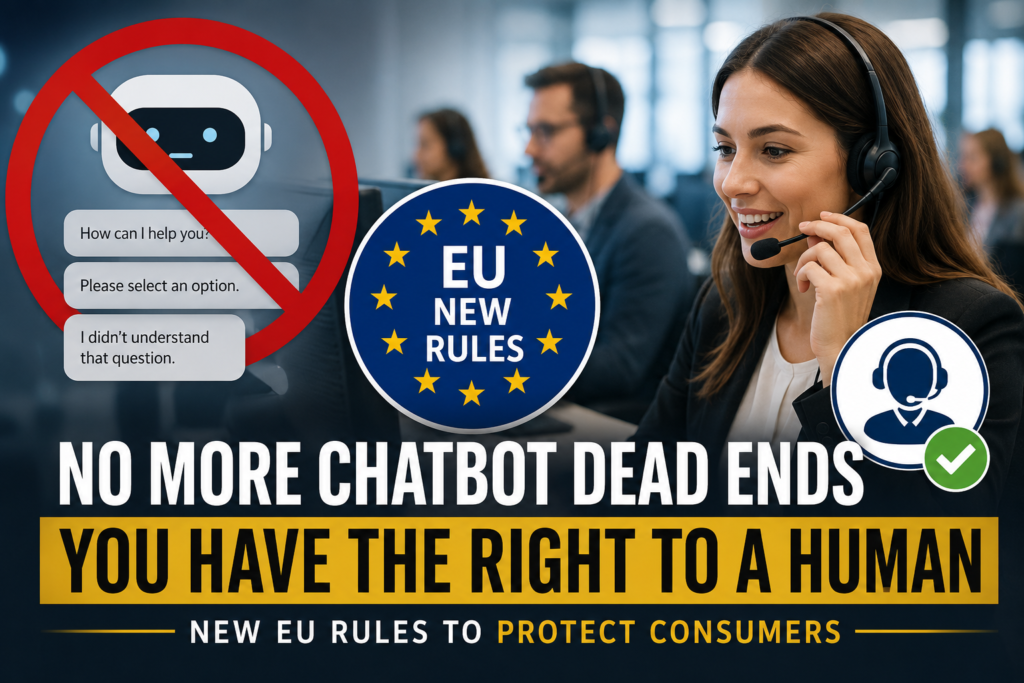
The EU is introducing new consumer protection rules allowing shoppers to request human customer support instead of AI chatbots. Discover what the new regulations mean for online retailers and consumers across Europe.
Europe – Online shoppers across the European Union will soon gain the legal right to request assistance from a human representative instead of being forced to interact only with AI-powered chatbots.
The new consumer protection measure, which is being implemented through the Department of Finance, aims to ensure that customers can access real human support whenever automated systems fail to resolve their concerns.
AI chatbots have become increasingly common as businesses seek to reduce costs and improve efficiency. While these systems can handle simple questions quickly, many consumers have expressed frustration over repetitive responses, limited understanding of complex issues, and difficulties resolving unique cases.
Speaking on Lunchtime Live, a caller identified as Garrett said he strongly prefers dealing with a real person rather than an AI assistant.
According to Garrett, conversations with human agents make it easier to explain problems in detail and reach a solution more efficiently. He argued that although chatbots can be useful for straightforward enquiries, they often struggle when faced with unusual or more complicated situations.


EU Gives Shoppers the Right to Speak to Humans Instead of AI Chatbot
Technology expert and TU Dublin lecturer Damian O’Reilly explained that today’s AI chatbots are significantly more advanced than traditional rule-based systems, which relied on pre-programmed responses and could not adapt to different questions.
He noted that modern artificial intelligence has improved dramatically, allowing chatbots to understand language more naturally and respond more intelligently than previous generations of automated support tools.
However, O’Reilly cautioned that AI still cannot consistently match the judgment of well-trained human professionals. He referenced research from Oxford, which found that AI chatbots achieved around 95% accuracy when medical experts entered patient information. In contrast, when patients entered their own symptoms, the chatbot’s accuracy reportedly dropped to approximately 35%.
The findings highlight one of AI’s biggest limitations: the quality of its responses depends heavily on the accuracy and completeness of the information it receives.
As AI continues to play a larger role in customer service, the EU’s new rules are designed to protect consumers by ensuring they always have the option to speak directly with a human when automated assistance is not enough.

Source: Adapted from reports on the EU’s upcoming consumer protection measures.
- (no title)
- Everyone Rooted for the Rise. Now They Want the Fall.
- Trump Shuts CNN, Politico and MSNOW Out of the White House
- Vance Backs White House Press Restrictions, Calls Targeted Outlets “Propaganda” Machines
- Spurs, Chelsea and Fulham RELEGATED? Our Shock 2026-27 Premier League Prediction Will Split the Nation